
AI Avatars vs. Real Spokespeople: What Works for Ads

AI Avatars vs. Real Spokespeople: What Works for Ads
If you want more ad versions at lower total spend, AI avatars often win. If you need trust to drive clicks, real spokespeople often do better. That’s the short answer.
When I look at this choice, I focus on 8 things: conversions, trust, engagement, speed, testing volume, localization, message consistency, and total cost. In most cases, AI fits low-consideration offers, while human talent fits health, finance, luxury, and other trust-heavy offers.
Here’s the simple takeaway:
- Use AI avatars for hook tests, product-led ads, language versions, and always-on output
- Use real spokespeople for testimonials, proof-based ads, and offers that need emotion or authority
- Use both when you want a human-led core ad plus AI-made cutdowns and extra versions
- Judge results by conversion rate and ROAS, not just views
- Compare total production spend, not only per-video price
A 2026 ad team may need 10, 20, or 50+ versions for TikTok, Instagram Reels, YouTube Shorts, Facebook, LinkedIn, and X. That’s where this choice starts to affect time, output, and budget fast.
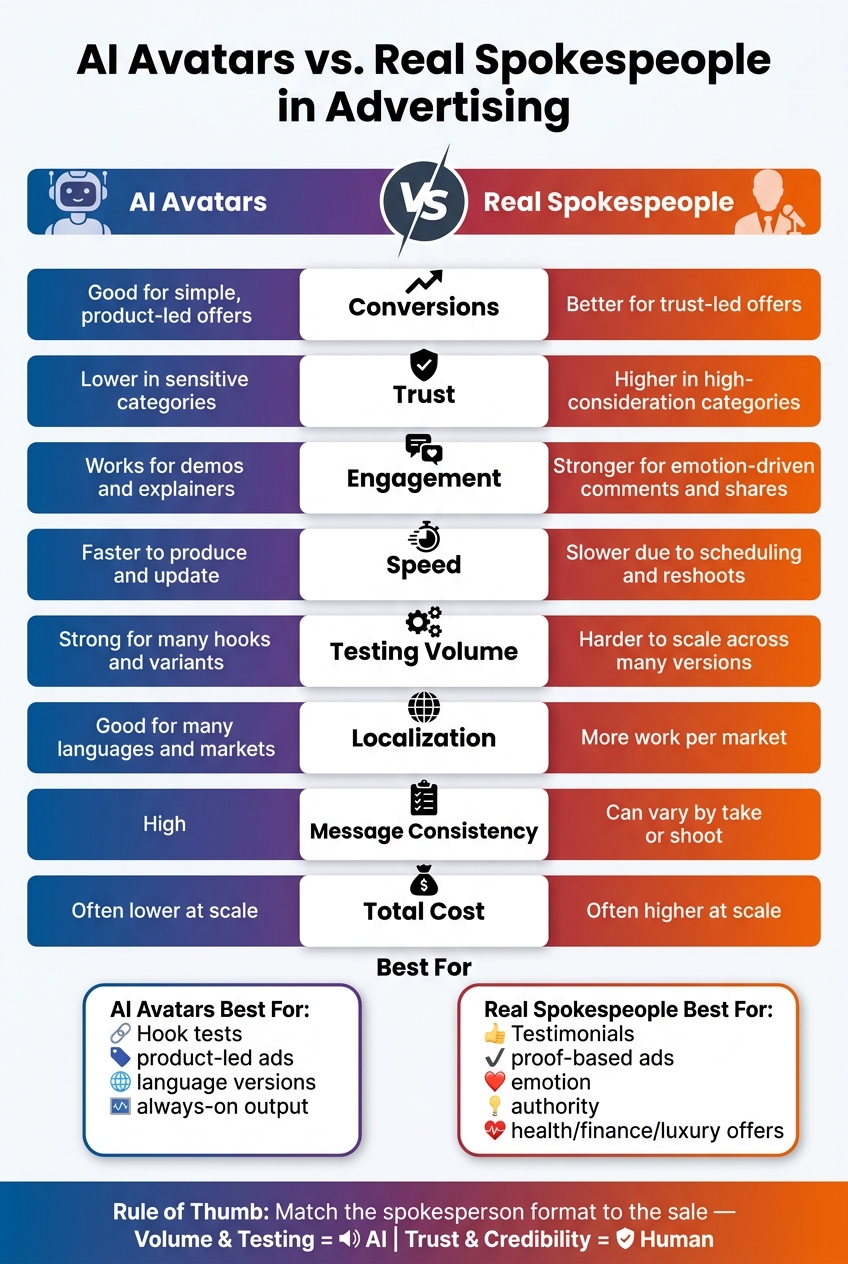
AI Avatars vs. Real Spokespeople: Ad Performance Comparison
Quick Comparison
| Criteria | AI Avatars | Real Spokespeople |
|---|---|---|
| Conversions | Good for simple, product-led offers | Better for trust-led offers |
| Trust | Lower in sensitive categories | Higher in high-consideration categories |
| Engagement | Can work for clear demos and explainers | Often stronger for comments and shares tied to emotion |
| Speed | Faster to produce and update | Slower due to scheduling and reshoots |
| Testing volume | Strong for many hooks and variants | Harder to scale across many versions |
| Localization | Good for many languages and markets | More work per market |
| Message consistency | High | Can vary by take or shoot |
| Total cost | Often lower at scale | Often higher at scale |
My rule of thumb is simple: match the spokesperson format to the sale. If the ad needs presence and proof, go human. If the ad needs volume and testing, go AI.
Below, I break down where each format works best across short-form ad channels and campaign goals.
AI Avatars vs. Real Spokespeople: Strengths, Limits, and Best-Fit Use Cases
Using those criteria, here’s where each format tends to win in day-to-day marketing.
Where AI Avatars Tend to Work Better
AI avatars make the most sense when brands need to test multiple hooks or offers fast, without dealing with reshoots. They’re also a strong fit for scaling across languages and markets, especially when speed matters and teams want more versions in less time.
Where Real Spokespeople Tend to Work Better
Real spokespeople are usually the better fit for high-consideration categories like health, finance, and luxury. In those spaces, empathy, authority, and emotional nuance often do the heavy lifting when it comes to trust.
Key Tradeoffs Brands Should Expect
| AI Avatars | Real Spokespeople | |
|---|---|---|
| Best for | Fast testing of multiple ad variations, plus language and market adaptation | High-consideration purchases such as health, finance, and luxury, where trust and emotional delivery matter most |
| Main advantage | Scale and testing efficiency | Trust, empathy, authority |
| Main limitation | Can fall short when human nuance and credibility matter most | Slower and more expensive when you need many versions |
These tradeoffs become clearer when you measure conversions, trust, engagement, speed, and cost.
How Each Format Performs Against Common Ad Goals
Those strengths play out in different ways based on the goal of the ad. AI avatars win on speed and output. Real spokespeople usually win on trust and persuasion. That split shows up pretty clearly in the metrics most teams care about.
Conversions, Trust, and Engagement
For direct-response ads, where the goal is a click or purchase, real spokespeople usually do better on trust-led conversions, especially in high-consideration categories. A human face, a personal story, or visible emotion can do a lot of the heavy lifting in a way an avatar still can't match.
AI avatars can still perform well in lower-stakes, product-led ads where the offer does most of the selling. If the message is simple and the value is obvious, an avatar may be more than enough.
When it comes to engagement, both formats can work. But real talent often gets more comments and shares when emotion is part of the pull.
Use AI when production speed matters more than presence; use real talent when credibility drives the click.
Speed, Scale, Localization, and Cost
AI avatars are at their best when you need to move fast and make a lot of versions. You can test multiple hooks, swap in new languages, or build market-specific cuts without booking reshoots. That keeps costs down and turnaround times short.
Real spokespeople are stronger when trust needs to carry the message. But that edge comes with tradeoffs. Scheduling, talent fees, and reshoots add time and budget, and those costs stack up fast when you're producing at scale.
Platform Fit Across Short-Form Channels
Platform context matters. The same format that works on one channel can feel off on another.
| Platform | AI Avatars | Real Spokespeople |
|---|---|---|
| TikTok | Good for product demos and hook testing | Stronger for UGC-style and trend-driven content |
| Instagram Reels | Works for polished product ads | Better for lifestyle and aspirational brand moments |
| YouTube Shorts | Effective for informational and explainer formats | Stronger for testimonials and authority-driven offers |
| Reliable for direct-response volume and A/B testing | Better for community-facing and trust-heavy campaigns | |
| Fits thought leadership scripts and B2B product ads | Stronger when executive presence or credibility is the message | |
| X | Works for fast, topical ad formats | Better when personality and voice drive the engagement |
When to Use AI, When to Use Human Talent, and When to Use Both
After weighing the strengths and limits of each option, the next step is simple: pick the format that fits the job of the campaign.
Choose AI Avatars for Volume, Testing, and Always-On Output
Use AI avatars when you need speed, scale, and a steady flow of new assets. They work well for fast hook tests, frequent creative refreshes, and lots of short-form variations.
In plain terms, AI is at its best when output matters more than personal presence. If the goal is to test many angles without slowing down production, this is usually the better fit.
Choose Real Spokespeople for Credibility, Proof, and High-Consideration Offers
Use real spokespeople when the ad needs to show proof, authority, or lived experience. A human face can do more of the trust-building work, especially when the offer asks for more thought before someone takes action.
That makes human talent the stronger choice when the ad needs to earn trust before the click.
Use a Hybrid Approach for Campaigns That Need Both
Sometimes the best move is to combine both. Use a hybrid setup when a campaign needs a human-led main message, plus AI-made cutdowns, hooks, or extra variations.
This split gives you the trust that comes from a real person, while still keeping production fast and flexible.
Conclusion: A Simple Framework for Choosing the Right Spokesperson Format
After looking at conversions, trust, speed, scale, and cost, the choice gets pretty clear: match the spokesperson format to the sale. Use AI avatars for low-consideration products. Use real spokespeople for offers where trust carries more weight and buyers need more reassurance.
Before you produce anything, run it through this quick filter:
- Low-consideration purchase? Use AI.
- Trust-heavy offer? Use real talent.
- Measure conversion rate and ROAS, not views.
- Compare total production spend, not per-video cost.
That last point matters more than a lot of teams think. If you judge success by views, you can end up chasing the wrong signal. And if you compare options only by per-video price, you might miss the full cost picture. A better way is to judge performance by conversion rate and ROAS, and judge cost by total production spend.
FAQs
How should I test AI vs. human ads fairly?
Use a controlled A/B test where the only difference is the spokesperson. Keep the script, visual pacing, calls to action, production quality, and budget the same in both ads.
Run both versions at the same time for the same audience segments. Then compare conversion rates and engagement to see which format works better for your audience.
What ad types work best with a hybrid approach?
The available information does not include details about advertising performance, AI avatars, real spokespeople, or hybrid ad strategies.
Because of that, it does not say which ad types work best with a hybrid approach.
When does AI save money at scale?
The search results don’t say when AI avatars start saving money at scale in advertising.
So based on the information available here, this question can’t be answered.