
In-House Video Team vs. Done-for-You Service: Key Differences
In-House Video Team vs. Done-for-You Service: Key Differences
If you need a lot of video every month, this choice comes down to one thing: control vs. simplicity.
I’d go with in-house when you need tight internal control, full-time staff, and room for constant back-and-forth. I’d go with done-for-you when you want steady output, lower overhead, and a clear monthly cost.
Here’s the article in plain terms:
- In-house means your team handles strategy, scripts, filming, editing, reviews, posting, and reporting.
- Done-for-you means a service handles most production work, while you review and approve the final videos.
- In-house cost in the article ranges from $180,000 to $350,000+ per year, plus $500 to $2,000 per month for tools and software.
- Done-for-you cost in the article ranges from $1,900 to $5,900 per month, based on 15, 30, or 60 videos per month.
- In-house gives you more say in day-to-day work, but output can slow down when staff are busy.
- Done-for-you gives you a simpler setup and easier scaling, but you need clear briefs, brand rules, and feedback.
The short takeaway: if your team has time, staff, and a steady video pipeline, in-house can fit. If your team is stretched and still needs weekly Reels, Shorts, TikTok ads, and multi-channel posting, a done-for-you service may fit better.
Quick Comparison
| Criteria | In-House Team | Done-for-You Service |
|---|---|---|
| Who does the work | Your staff | Outside service |
| Upfront setup | Hiring, tools, gear, process | Onboarding and brand setup |
| Cost structure | Payroll + software + equipment | Flat monthly fee |
| Cost range in article | $180,000 to $350,000+ yearly, plus tools | $1,900 to $5,900 monthly |
| Turnaround | Depends on staff load | Set by service plan |
| Control | Higher | Lower, with approval rights |
| Scale | Add people to add output | Change plan to add output |
| Posting and analytics | Your team handles it | Included in some plans |
So before I choose, I’d look at video volume, deadline pressure, approval load, and total monthly spend. Those four points usually make the answer clear.
What It Takes to Run an In-House Video Team
An in-house video team gives brands direct control. That can be a big win. You keep the work close, the feedback loop is tighter, and the team knows the brand inside and out.
But that control comes with a catch: more moving parts. You need people, tools, and a workflow the team can repeat without things falling apart. If not, output gets uneven fast.
Workflow, Roles, and Ongoing Costs
Video production usually follows a clear path: strategy → scripting → production → editing → approvals → publishing → reporting. Every step needs a person who owns it. Otherwise, work stalls, files get lost, or feedback starts bouncing around like a pinball.
A lean in-house setup often includes:
- Marketer or strategist - sets content goals, shapes messaging, and ties video output to campaign priorities
- Producer or project manager - manages timelines, organizes assets, and keeps the process on track
- Videographer or content creator - handles filming, b-roll, and raw footage capture
- Editor - cuts footage, adds graphics and captions, and formats videos for each platform
- Approver - checks the final asset for brand accuracy, legal compliance, and quality before it goes live
Then there’s the cost side.
Salaries for a lean video team can range from $180,000 to $350,000+ per year, depending on the market and each person’s level of experience. On top of that, most teams pay for editing tools, project management software, and analytics platforms, usually around $500 to $2,000 per month. You also need equipment: cameras, lighting, audio gear, and storage.
And one cost tends to sneak up on teams: management time. Hiring, onboarding, training, and day-to-day oversight all add overhead. It may not show up in the first draft of the budget, but it still hits the business.
When an In-House Team Makes Sense
This model works best when video volume is high and steady. It also fits brands that need a strong grasp of brand voice, especially when that voice depends on deep internal knowledge.
In-house can also be the right call when production involves proprietary assets, internal talent, or locations that an outside team can’t use. The same goes for brands that need to move fast and adjust based on internal feedback in near real time.
When an In-House Team Slows Down or Costs More
The biggest issue is usually capacity.
If one editor is juggling several campaigns, turnaround times start to slip. If approvals need sign-off from multiple people inside the company, each asset can lose days before publishing. And if demand jumps, scaling up usually means hiring more staff, which takes both time and money.
There’s also the quiet downside of fixed payroll. During slower periods, salaries still have to be paid, even if output drops.
That structure works best when volume is steady and the team can absorb the workload.
How a Done-for-You Video Service Works
A done-for-you (DFY) video service takes care of video production from brief to delivery, while your team keeps final sign-off. In plain English: you get finished videos without having to build an in-house production team.
For brands putting out Reels, Shorts, and paid social content every week, the big win is steady output on a recurring basis. You’re trading some hands-on control for faster delivery and more consistent publishing.
Sun Scroller's Workflow for Recurring Social Video
Sun Scroller is built for recurring social video, with weekly concepts and repeatable delivery baked into the process. The team comes up with weekly TikTok ad concepts and hook variations, moves those ideas through production, and delivers videos formatted for each platform before posting.
That includes product ads and direct-response ads with multiple hook versions. So if your internal team is stretched thin, output can still stay consistent.
Sun Scroller also provides per-channel analytics that show which hooks and formats are worth repeating the next month. That makes the setup a good fit for brands that need a steady stream of content, platform-specific edits, and faster turnaround.
What Sun Scroller Includes
Every plan begins with a brand voice and style guide built in month one. After that, the service covers a wide range of recurring video needs, including:
- Short-form videos, Reels, Shorts, and video ads
- AI avatars, digital presenters, synthetic UGC, and voice cloning
- Branded mascots, stylized characters, AI-generated B-roll, product cutaways, and before-and-after visuals
Monthly posting across YouTube, TikTok, Instagram, Facebook, X, and LinkedIn is included. You also get per-channel analytics and a monthly strategy call.
Plans are based on volume:
| Plan | Videos/Month | Monthly Cost |
|---|---|---|
| The Operator | 15 | $1,900 |
| The Authority | 30 | $3,600 |
| The Category Leader | 60 | $5,900 |
All plans include asynchronous approval. That means no meetings are needed to review and approve content before it goes live.
Benefits and Tradeoffs of the Service Model
The biggest upside is speed. Production can start without hiring, training, or setting up an internal team. If you want more output, you switch plans instead of adding headcount.
The tradeoff is simple: the service works best when the client gives strong briefs and clear feedback. If volume is the top goal, brand guidelines and revision rules matter a lot.
Before you start, make sure you confirm:
- How many revision rounds are included
- Who owns the AI-generated assets
- Which accounts the service can access for publishing
- What the analytics reports include
Those details shape cost, control, and turnaround.
Cost, Speed, Control, and Scale: How the Two Models Compare
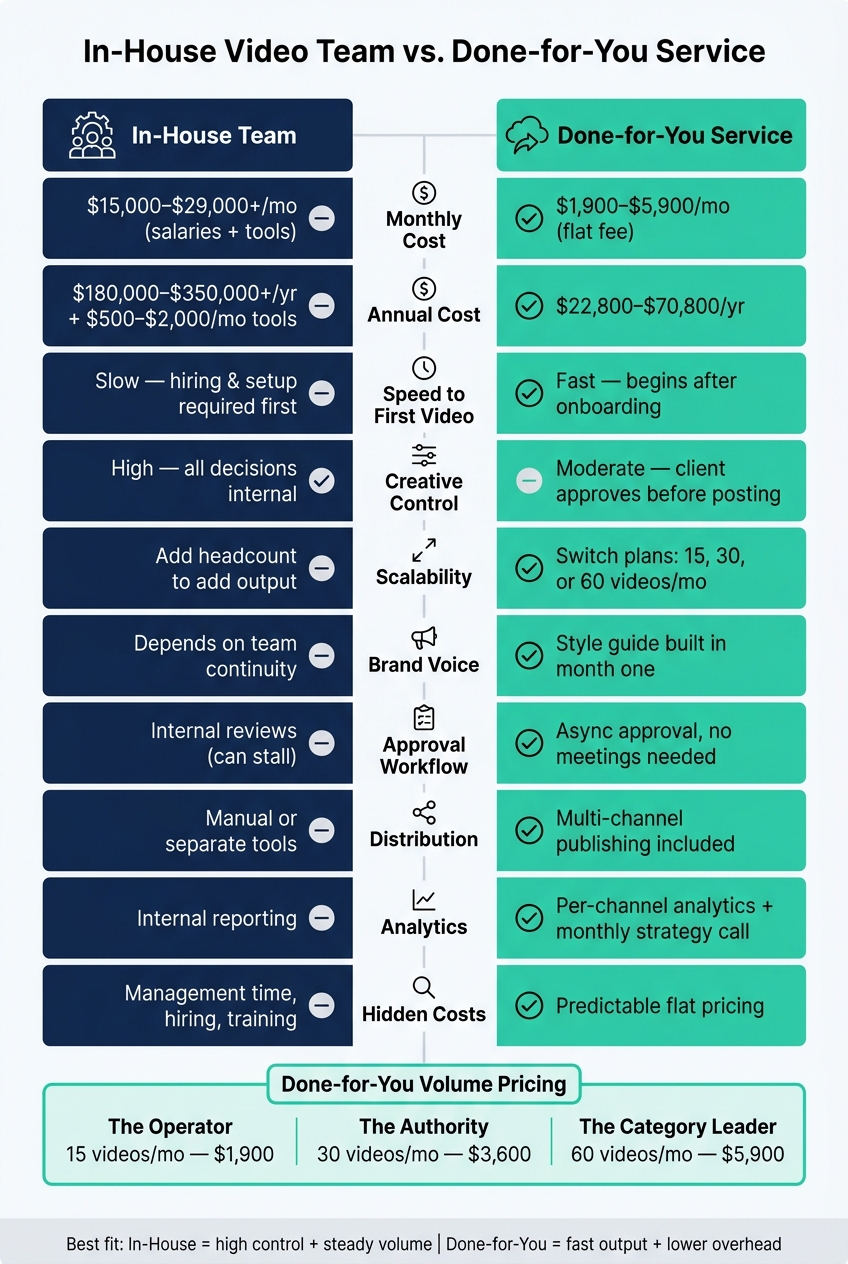
In-House Video Team vs. Done-for-You Service: Cost, Speed & Scale Compared
The choice usually comes down to four things: cost, speed, control, and scale.
Comparison Table: Key Decision Criteria
The simplest way to compare the two is to look at what affects day-to-day production.
| Criteria | In-House Team | Done-for-You (Sun Scroller) |
|---|---|---|
| Monthly cost structure | Fixed overhead - salaries, benefits, payroll taxes, software, equipment, and training | Flat monthly subscription tied to output volume |
| Hidden costs | Coordination time and internal management | Predictable monthly pricing |
| Speed to first video | Slower to ramp because hiring and setup happen first | Recurring production begins after onboarding |
| Creative control | High - decisions stay inside your team | Client approves before posting |
| Brand voice consistency | Depends on team continuity and documentation | Brand voice and style guide built in month one |
| Approval workflow | Internal reviews can move fast or stall | Async approval, no meetings required |
| Scalability | Adding output usually means adding headcount | Scale from 15 to 30 to 60 videos per month |
| Platform expertise | Varies by hire | Built-in across major social platforms |
| Performance accountability | Internal reporting | Per-channel analytics and a monthly strategy call |
| Distribution | Usually manual or handled with separate tools | Multi-channel publishing included |
The biggest split is the cost structure.
An in-house team comes with fixed overhead whether you publish 5 videos or 50 in a given month. You’re paying for salaries, tools, and team time either way.
A flat-fee service works differently. Cost is tied to output volume, which makes budgeting easier and a lot less murky.
Example Scenarios: Weekly Ads, AI Videos, and Multi-Channel Publishing
You see these tradeoffs most clearly in day-to-day workflows.
Scenario 1 - Launching weekly TikTok ads with multiple hooks.
A skincare brand needs weekly TikTok ads with multiple hooks. With an in-house setup, the team has to coordinate scripting, editing, and review on its own. Sun Scroller runs that workflow on a recurring cadence.
Scenario 2 - Producing AI avatar explainers without a shoot.
A SaaS company wants a series of product explainers using an AI presenter - no camera crew, no studio rental, no on-camera talent. Sun Scroller can produce the series with an AI presenter, with no shoot required.
Scenario 3 - One product ad across six channels.
A mid-size e-commerce brand approves a single product ad and needs it reformatted and posted across six platforms. In-house teams need to format and schedule each channel one by one. The brand approves once, then the video is published across six channels without extra coordination.
Which Model Fits Your Team
After weighing cost, speed, control, and scale, the decision comes down to fit. Pick the model that lines up with your output, deadlines, and the time your team can actually give to production.
Choose In-House When You Need Direct Internal Control
Go in-house when video production is a core part of how your team works, security or compliance rules are strict, and output is steady enough to justify full-time staff.
If you don't need that much internal ownership, a service model is usually the simpler option.
Choose Done-for-You When You Need Consistent Output Without Hiring
Go with done-for-you when your team can lead strategy but doesn't have the bandwidth to build and run production in-house. If you need recurring output - Reels, TikTok ads, multi-channel publishing - without adding headcount, a service model gives you speed, steady delivery, and less work for your internal team.
Conclusion: Match Your Volume, Deadlines, and Total Cost to the Right Model
Look at your volume, launch speed, and total cost. Then compare that with what a done-for-you service can handle at the output level you need. From there, choose the model that fits your goals, timeline, and budget.
FAQs
How do I know which model fits my team?
I can’t answer that from the search results you shared because they don’t cover how to choose between an in-house video team and a done-for-you video service.
If you send the right source material or the missing results, I can turn it into a clear recommendation for Sun Scroller’s blog, written for a U.S. audience.
What hidden costs should I budget for?
For an in-house video team, don’t stop at base salaries. The bigger bill usually includes a few extra line items that can sneak up on you:
- recruitment and onboarding
- hardware and software licenses
- benefits, office space, and equipment maintenance
It also makes sense to budget for skill building over time. Social media trends shift fast, and platform rules can change without much warning. If your team isn’t keeping up, the work can start to feel dated pretty fast.
How much control would I give up?
With a done-for-you video service, you trade some direct, detailed control for a smoother, more hands-off process.
You still set the initial brief, brand guidelines, overall direction, and final sign-off. But the service takes care of daily production, technical edits, and the actual creative work.