
7 Video Angles Brands Use in UGC-Style Ads
7 Video Angles Brands Use in UGC-Style Ads
If I want a UGC-style ad to sell, I keep it simple: one angle, one promise, and proof on screen. That’s the whole point of this article.
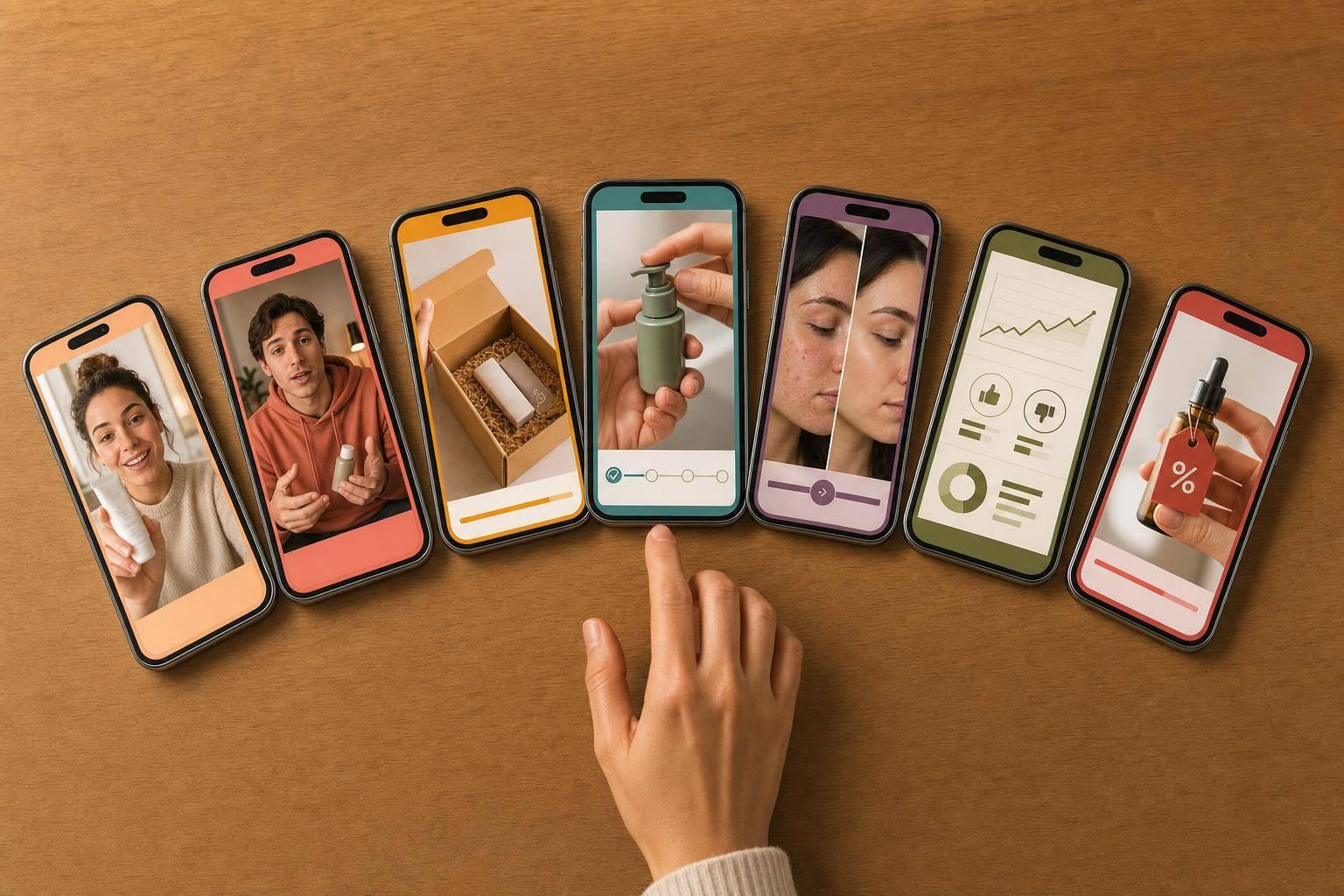
Here’s the short version: the article breaks UGC-style ads into 7 clear angles I can use to sell a product in short-form video:
- First-use reaction
- Before-and-after
- Routine fit
- Problem callout
- Side-by-side comparison
- Objection answer
- Deal-led offer
The main lesson is simple: pick one sales idea per video. Then I support it with a strong opening hook, show the product early, and back the claim with footage that matches what I’m saying. That matters because short-form ads often win or lose in the first 1–3 seconds.
A few points stand out:
- I should hook fast
- I should show the product early
- I should stick to one message
- I should match visuals to the claim
- I should test hooks, creators, offers, and video length
Not every product needs the same type of ad. Some products sell best with a visible change. Others work better when I show a daily use case, answer one buyer concern, or lead with a discount like $20 off or Buy 2, Get 1 Free.
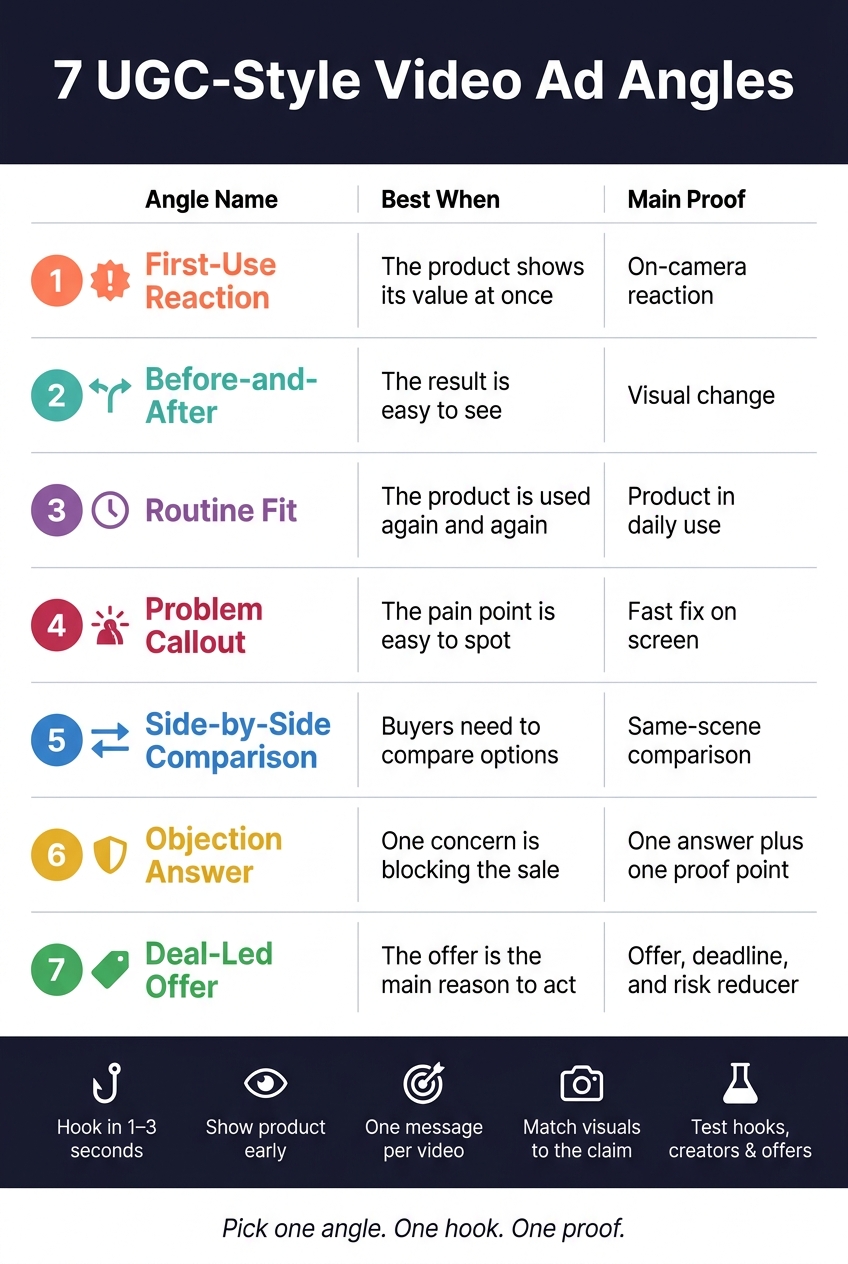
7 UGC-Style Video Ad Angles: When to Use Each & What Proof to Show
Quick Comparison
| Angle | Best when | Main proof |
|---|---|---|
| First-use reaction | The product shows its value at once | On-camera reaction |
| Before-and-after | The result is easy to see | Visual change |
| Routine fit | The product is used again and again | Product in daily use |
| Problem callout | The pain point is easy to spot | Fast fix on screen |
| Side-by-side comparison | Buyers need to compare options | Same-scene comparison |
| Objection answer | One concern is blocking the sale | One answer plus one proof point |
| Deal-led angle | The offer is the main reason to act | Offer, deadline, and risk reducer |
In short, this article is a playbook for turning short-form UGC-style ads into clear sales videos that are easier to test and judge.
What Makes a UGC-Style Video Angle Work
A good UGC-style angle is usually pretty simple: hook people fast, show the product early, make one clear promise, and prove it. That’s what keeps the ad focused, believable, and built to drive action. Use the checklist below to tighten up the seven angles that follow.
Fast hook in the opening seconds
The opening does a lot of the heavy lifting. Your hook should show a result, point to a problem, or lead with a visual that makes someone stop scrolling.
If the ad starts too slowly, or opens with a generic greeting, people may skip before your point even lands.
Early product visibility
Show the product right away so people know what’s being sold. Even a quick close-up or a short shot of the product in use helps anchor the message.
That early visual also keeps the ad from feeling fuzzy or disconnected.
One core promise per video
One ad usually works best when it sticks to one main idea. Instead of piling on benefit after benefit, center the video on one clear reason to care.
That makes the message easier to remember. It also makes the angle easier to judge when you test performance.
Conversational delivery and matching proof
UGC-style delivery works when it sounds natural, not stiff or over-scripted. People can sense when a line feels forced.
That trust gets stronger when the visuals back up what the speaker is saying. If the ad makes a claim, the footage should help show it in a way that feels immediate and concrete. In plain English: match the proof to the promise.
Test hooks, creators, offers, and edit lengths
Test hooks, creators, offers, and edit length. Keep the core angle the same, then change the execution around it.
For recurring volume, Sun Scroller can produce monthly short-form videos, AI avatars, synthetic UGC, and product ads with approval controls. Each angle in the next section uses this structure in a different way.
1. First-Use Reaction
Use this angle when the product makes its case right away. First-Use Reaction puts a creator on camera trying the product for the first time and responding in the moment.
Why does it work? People tend to trust a live response more than a polished claim. It gives viewers a quick feel for what using the product is actually like.
This is a trust-first sales angle built on immediate proof. Keep the moment natural. Show the first real reaction on camera. It works best when that reaction is the proof.
2. Before-and-After Transformation
When the product leads to a visible change, put that change front and center. This angle works best when people can see the result on camera instead of just hearing about it.
Start with the problem. Then show the product being used. Then show the result. Keep the shift clear in a single shot if you can.
The key is simple: let the footage do the talking. Don’t lean only on the claim when the visual can prove the point.
This approach lands best when the outcome is easy to show on camera.
3. Routine Fit
When a product shines through repeat use, don’t frame it around some big before-and-after story. Frame it around routine. Show how it slides into a daily habit, a weekly reset, or a specific moment with little effort. Once people can see it in their own lives, it feels easier to try.
The point here is simple: show where the product fits, not treat it like a standalone fix.
Start with the setting, then the product, then the moment it’s used. A Day in the Life format works well because the product becomes part of the story instead of taking over the whole thing.
Open with the routine itself - the habit or moment where the product belongs. Then bring in the product as the natural next step. It should feel woven into the routine, not dropped on top of it. Proof comes from believable use inside a real routine and clear product-in-use shots that make the use case feel real. This angle works best for products people use again and again.
If routine fit isn’t the clearest way in, lead with the pain point instead.
4. Problem Callout
When routine fit feels a bit too quiet, problem callout puts the pain point front and center. The idea is simple: lead with a frustration the viewer already knows. And the more specific you get, the better. Not “cleaning is annoying,” but “crumbs stuck in the sliding door track.” That kind of detail makes the message feel immediate and familiar.
Start with the problem right on screen, in plain English. A “POV” overlay or a “Stop doing [X]” hook tells people, almost instantly, that the ad speaks to them. Then the product reveal doesn’t feel random. It feels like the obvious next move.
From there, keep the script tight. Name the problem, make the frustration sting for a second, then show the product fixing it right away. That’s the whole flow: problem, agitation, solution, payoff. No long setup. No detour. Just the issue, the fix, and proof that it works.
This angle works best when the problem is easy to spot and the solution can be shown fast.
5. Side-by-Side Comparison
If the problem is clear but the choice still isn’t, put the product right next to the option it beats.
Use this angle when the buyer needs to make a fast call. Show the product beside what it replaces - maybe a common workaround, an older method, or another approach - and make the difference easy to spot.
Why does this work so well? Because people don’t have to guess at the tradeoff. They can see it for themselves. When both options show up in the same frame, the viewer can judge on the spot: faster, cleaner, simpler, less messy, or more complete. Keep the setup simple, keep the visuals clear, and keep the claim narrow so the comparison feels believable.
There’s one rule that matters more than anything else: change one variable at a time. Swap in the product, keep everything else the same, and let the visual carry the message. The winner should be obvious without a voiceover walking people through it. If it takes a long explanation, the comparison is probably too complicated.
This angle works best when the gap between the two options is easy to see on camera and the decision can happen in a few seconds.
6. Objection Answer
When a buyer has one last reason to hesitate, use an objection answer. Start with the biggest concern right away - price, fit, effort, or trust - and answer it on the spot.
Keep it tight. Focus on one objection and one clear answer. Then add one proof point that backs up that answer. The proof should match the exact concern you're addressing, not something close to it.
7. Deal-Led Angle
Use this angle when the offer itself is the main reason someone should act. Put it front and center in the first two seconds.
Make the offer impossible to miss with large, high-contrast on-screen text. Think "$20 off your first order" or "Buy 2, Get 1 Free - Ends 10/31/2026." A lot of people watch with the sound off, so the deal needs to be clear right away.
After that, keep the script simple: what the offer is → who it's for → why now → what to do next. The "why now" part matters more than most people think. If urgency sounds vague or made up, people tune it out. But a clear deadline like "Ends 10/31/2026" gives them a solid reason to move now.
Then add two things that help close the gap between interest and action: one proof point and one friction reducer. For example, "Over 12,000 five-star reviews" paired with "60-day money-back guarantee." One builds trust. The other lowers the risk.
Use this table to map the offer before you write the script.
| Offer Component | Purpose | U.S. Example |
|---|---|---|
| Incentive | Gives a reason to act | "$20 off first order" or "Buy 2, Get 1 Free" |
| Urgency | Answers "Why now?" | "Ends 10/31/2026" or "Only 200 left" |
| Risk Reversal | Removes purchase doubt | "60-day guarantee" or "Free shipping today" |
| Call to action | Directs the next step | "Shop now" or "Tap the link in bio" |
Quick Visual Planning Tables
These tables help turn each angle into a clean shot plan. The goal is simple: keep every angle visual, clear, and tight.
Start with the visual sequence. Then match the proof to the promise.
Before, product-in-use, and after table
Map the before, the product in use, and the after so the change reads right away.
| Stage | What to Show | Viewer Takeaway |
|---|---|---|
| Before | The problem or initial condition | What things look like before the product |
| In use | The product being used in a real moment | How the product fits into the scene |
| After | The after state or outcome | What changed after use |
Problem, feature, proof, and claim table
Map the problem to the feature, then to the proof on screen. That way, the B-roll and product-in-use footage make the ad feel believable.
| Problem | Feature | Proof | Claim to Make |
|---|---|---|---|
| Pain point | Feature tied to the pain point | Visual proof on screen | Keep the claim aligned with the proof |
Comparison setup table
Keep the setup controlled so the difference is easy to see.
| Comparison Variable | Same Setup | Observable Result |
|---|---|---|
| Comparison point | Same setup on both sides | Clear difference on screen |
Offer structure table
Lay out the offer details before you shoot.
| Component | Include |
|---|---|
| Standard price | Regular price |
| Promotional price / bundle value | Deal or bundle details |
| Offer period | Start and end of the offer |
| Conditions | Eligibility and redemption details |
| Disclosure | Any required disclaimer |
Once the angle is mapped, test variations around the same core structure.
How to Apply These Angles in a Recurring Video Program
Once you’ve mapped an angle, use it as the starting point for repeatable ad testing.
Build one angle per ad concept
Each ad should center on one angle, one hook, and one proof path. That keeps the next test cycle clean and makes it much easier to see what changed and what worked.
Test variations around the core angle
Each of the seven angles above works as a fixed base. Keep that angle the same, then test the execution around it: the hook, the delivery style, and the edit length.
That way, you’re not changing everything at once. You’re testing the presentation, not the idea behind it.
Use a recurring production system when volume matters
When a brand needs a steady flow of short-form content, the process has to be repeatable. Otherwise, production gets messy fast.
For brands that need that kind of output, Sun Scroller produces monthly UGC-style ads, AI avatars, product demos, and before-and-after videos. It also supports approved publishing and channel analytics across major social channels.
Conclusion
Short-form UGC tends to work best when each ad pushes one clear angle. That’s why the seven angles above are effective.
Each one gives the viewer a single reason to act: reaction, transformation, routine fit, problem, comparison, objection, or offer. It’s the same sales promise delivered from a different direction. The goal is simple: cut the clutter so the offer lands fast.
Across all seven, the rule stays the same: lead fast, stay specific, and show proof on screen. That structure is a solid starting point for testing.
Pick the angle that fits the message, build the ad around one idea, and test a few variations from there.
FAQs
How do I choose the right angle for my product?
Match the angle to your marketing goal.
If your audience still needs a bit of context, lead with a problem callout or objection answer. Those angles work well when you need to teach, clear up doubts, or explain why the product matters in the first place.
If you want to show how the product fits into day-to-day life, go with routine fit or before-after. These formats make usage feel concrete and easy to picture.
For high-intent shoppers, deal-led and first-use reaction angles can move things along faster. They tap into urgency and help people get from interest to action with less friction.
Sun Scroller can produce these video formats for your brand across social platforms.
What kind of proof should I show in each ad?
Match the proof to the sales angle. If you want to sell the first experience, show first-use reactions that feel honest and specific. If you want to prove results, show clear before-and-after outcomes people can see right away. And if routine matters, show how the product fits into daily life without making it look forced.
Side-by-side comparisons work well because they make performance gaps easy to spot. They also help cut through doubt. Instead of just telling people what the product does, show it in action and answer objections with direct demos that deal with common concerns head-on.
What should I test first in a UGC-style ad?
Lead with the problem callout angle. It speaks straight to a clear pain point, so you can grab attention fast and show people this ad is for them.
Once that hook starts pulling its weight, test other angles like before-and-after or objection-answer ads to sharpen your conversion strategy.