
Facebook organic vs paid video: when each works
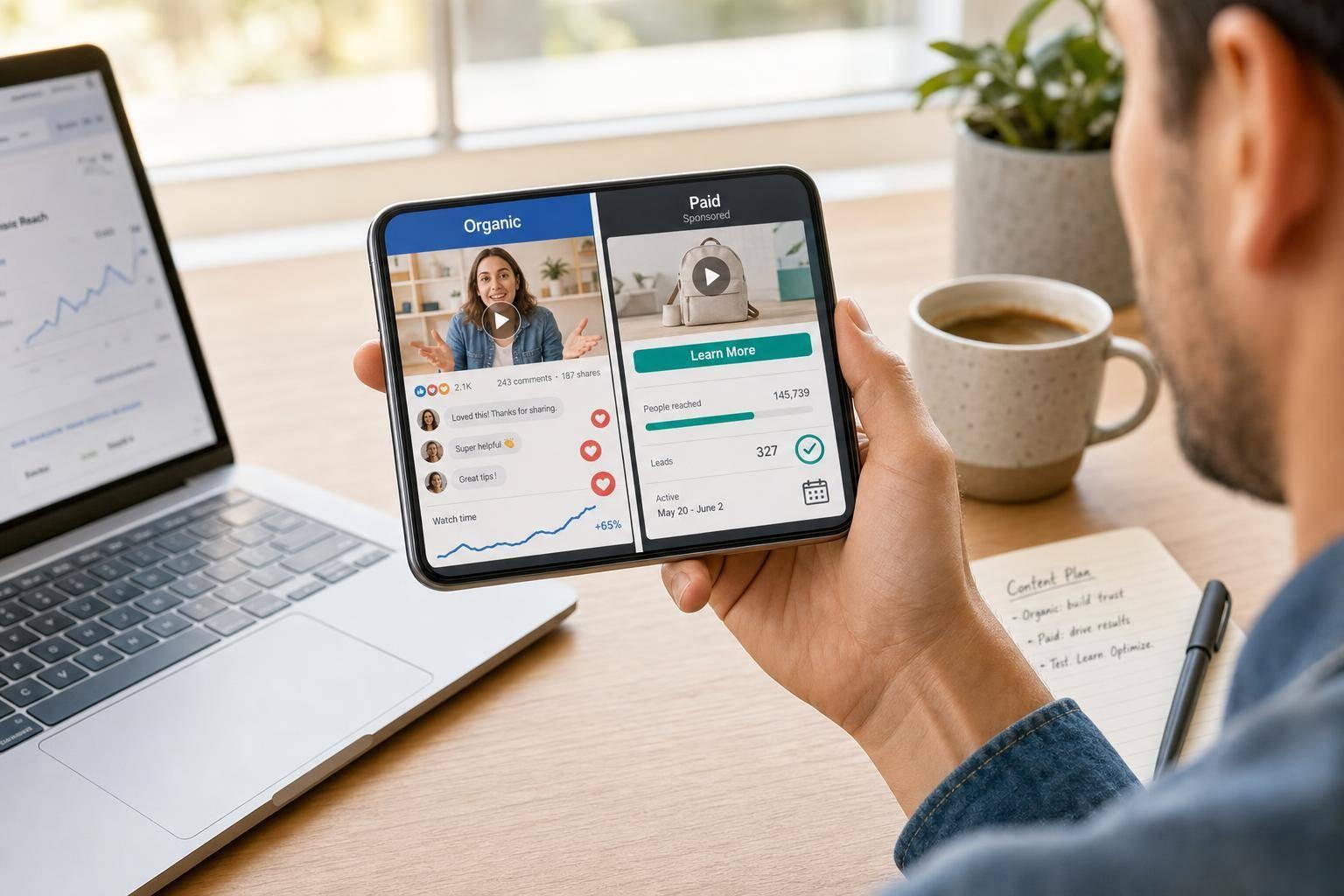
Facebook organic vs paid video: when each works
Here’s the short answer: use organic Facebook video for trust, testing, and community; use paid video for reach, timing, leads, and sales.
If I had to boil the whole topic down, I’d say this:
- Organic video works best when I want to teach, stay visible, and see what people respond to.
- Paid video works best when I need a set audience, a set budget, and a set result.
- Organic is low-cost, but reach is less predictable.
- Paid costs money, but I get more control over who sees the video and when.
- The best setup is often both: test with organic first, then put ad spend behind the videos that show strong watch time, shares, comments, or profile visits.
A simple way to think about it: organic warms people up; paid pushes action.
That matters because Facebook usage is still huge - Meta reported more than 3 billion daily active people across its apps in recent years, which means the platform can still be a strong place to post video and run ads when the goal is clear.
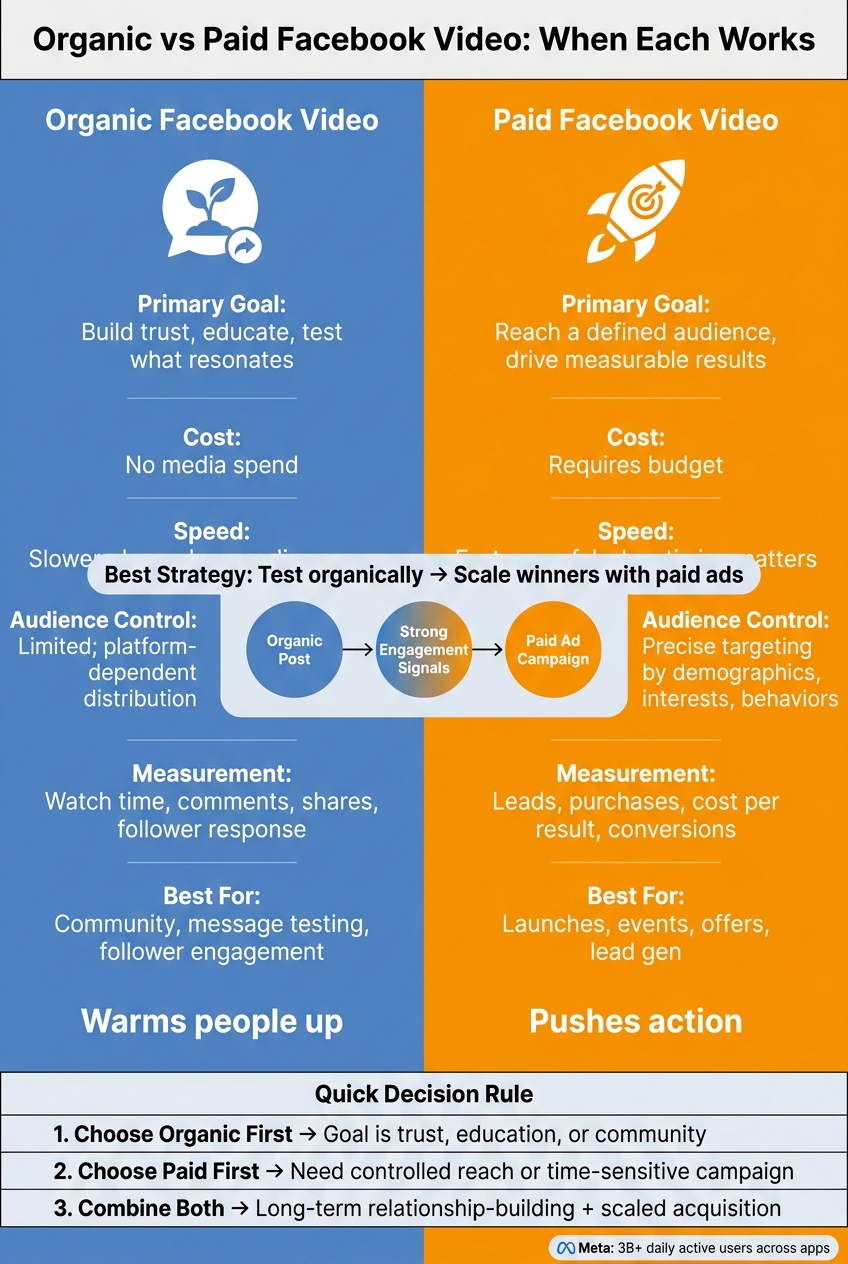
Organic vs Paid Facebook Video: Side-by-Side Comparison
Quick comparison
| Factor | Organic Facebook video | Paid Facebook video |
|---|---|---|
| Main goal | Trust, education, audience response | Reach, leads, sales, promotion |
| Cost | No ad spend | Needs budget |
| Delivery | Depends on platform response | More controlled |
| Speed | Slower | Faster |
| Audience targeting | Limited | More precise |
| Best for | Community, message testing, follower engagement | Launches, events, offers, lead gen |
| Main metrics | Watch time, comments, shares, follower response | Leads, purchases, cost per result, conversions |
If I’m choosing between the two, I look at six things: goal, budget, reach, speed, testing, and sales use. That gives me a clean way to decide whether to post for free, run an ad, or do both.
The rest of the piece can now go deeper into each case without repeating the basics.
Where organic Facebook video works best
Organic video is a slow-burn channel. It tends to work best for trust, familiarity, and brand voice. Since you’re not paying for distribution, it’s also a smart place to test formats and messages before putting money behind ads.
On the decision framework used throughout this guide, organic wins on budget and testing - not reach or speed.
Best use cases for organic video
Organic video is a strong fit for people who already follow or know your brand. It helps you educate followers, keep them engaged, and spark discussion.
It can also teach you what lands and what falls flat. Each post gives you a clearer read on which formats and messages connect, so your next move isn’t a guess.
What organic video needs to perform well
The main value of organic video is steady relationship building and audience feedback. That makes it a good starting point when you want insight before scale.
If speed, scale, or guaranteed delivery matter more, paid video is usually the better move.
Where paid Facebook video works best
Paid Facebook video plays by a different set of rules than organic video. With paid, you decide who sees the video, when it runs, and how often it shows up. That kind of control makes it a strong fit for targeted campaigns with a set deadline. If timing or reach can't slip, paid matters more.
Paid video works best when you need steady delivery to a specific audience on a fixed schedule. You can target people by demographics, interests, and behaviors, including people who have never heard of your brand.
That level of control becomes a big deal when you're promoting a time-sensitive launch, event, or offer. Paid gives you more say over delivery volume and timing, which helps when you need to hit an impression or view goal by a certain date. It also lets you run ads that don't appear on your public Page.
Use paid when reach, timing, or delivery certainty matters more than organic lift. The next step is lining up that paid setup with the right Meta campaign objective.
When reach and timing make paid video the right call
Use paid when you need to get past your current follower base on a fixed timeline. Organic alone may not move fast enough for a time-sensitive launch, event, or offer.
Match paid video to Meta campaign objectives
The best paid video campaigns start with a clear goal. Use paid when reach, timing, or delivery certainty matters more than organic lift.
Organic vs. paid Facebook video: side-by-side comparison
Organic and paid Facebook video do different jobs.
Organic helps you build trust over time. It’s a good fit when you want to teach, stay visible, and see what your audience reacts to. Paid is built for reach and results. It helps you get in front of a set audience and track what happened afterward.
Use the table below to line up the format with your goal, budget, timeline, and conversion needs.
Decision factors that matter most
| Decision factor | Organic Facebook video | Paid Facebook video |
|---|---|---|
| Primary goal | Build trust, educate, and test what resonates | Reach a defined audience and drive measurable results |
| Budget | No media spend, but limited distribution control | Requires budget, but buys delivery |
| Speed | Slower; depends on audience response | Faster; useful when timing matters |
| Audience control | Limited; performance depends on how the platform distributes the content | More control over who sees the video through targeting |
| Measurement focus | Engagement signals: watch time, comments, shares, and follower response | Results tied to the objective, such as leads or purchases |
| Lead and sales use cases | Better for warming audiences | Better for direct lead and sales campaigns |
How organic and paid video are measured differently
After you pick a format, measure it by the standards that fit that format.
For organic video, focus on watch time, comments, shares, and follower response. Those signals show whether the content is landing with people. For paid video, track the outcome tied to the campaign goal, like leads or purchases. Engagement can still help you read performance, but it shouldn’t be the main test if the campaign was built to drive action.
That’s where people often get tripped up. If you judge a paid video by comments alone, you can miss whether it actually drove leads or sales. And if you judge an organic video like a campaign, you might overlook content that’s doing its job by warming up your audience and building interest over time.
When to use each approach - and when to use both
Match your approach to your goal: awareness, trust, leads, sales, and promotions
Pick your path based on what you need most: awareness, trust, leads, sales, or promotions. The earlier factors - goal, budget, reach, speed, and testing value - make the choice a lot easier.
Building awareness? Start with organic video. Post a few videos first, see what people respond to, and then put money behind the one that performs best.
Building community and trust? Go with organic when familiarity matters more than raw reach. If you want people to know you, like you, and keep coming back, organic gives you more room to do that.
Generating leads? Use organic to warm people up first. Once you know the message is landing, switch to paid lead campaigns to turn that interest into action.
Driving sales or running a time-sensitive promotion? Use paid when timing and reach matter most. Just make sure your landing page, tracking, and follow-up are ready before you scale.
How to run an organic-to-paid workflow
When organic content shows that a message works, move from testing to scale. Don’t boost posts at random. Test first. Then scale with purpose.
Start by publishing a few videos organically. Then look at signals like:
- retention
- comments
- shares
- profile visits
- question quality
Those signals tell you which ideas are connecting. From there, turn the strongest video into a paid ad tied to a specific Meta objective, not just a boosted post.
Final decision checklist
Use this as a fast rule of thumb:
- Choose organic first when your goal is trust, education, community, or message discovery.
- Choose paid first when you need controlled reach, have a time-sensitive campaign, or are set to run lead capture or direct sales activity.
- Combine both when you want long-term relationship-building and scaled acquisition at the same time - organic warms the audience, paid converts them.
- Delay paid scaling if your creative hasn’t been tested, your audience isn’t clear, or your conversion path isn’t ready.
FAQs
How much should I spend on paid Facebook video?
The available information doesn’t say how much you should spend on paid Facebook video ads.
That number depends on a few things: your goals, your total budget, and what you want the video campaign to do. For example, you might use paid video to get more reach, test new ideas, bring in leads, or drive sales.
When should I turn an organic video into an ad?
Consider turning an organic video into a paid ad when it shows strong early performance, like high engagement or solid organic reach. That usually means it’s landing with the right people.
When you promote a post that’s already doing well, you’re not starting from scratch. You’re putting more budget behind something that has already shown it can get attention. That can help you reach a larger audience and push what’s already working even further.
Should I boost a post or build a full ad campaign?
Boost a post when one post is already doing well and you want to get it in front of more people FAST. It’s a simple way to add reach beyond organic distribution, and it works well when you don’t need all the audience testing and conversion setup that comes with a full campaign.
Build a full ad campaign when you’re ready to test budgets, audiences, and multiple ad creatives against a clear goal, like leads or sales. A campaign gives you more control and more room to optimize over time than a single boosted post.