
AI Video CTR by Platform: What Changes
AI Video CTR by Platform: What Changes
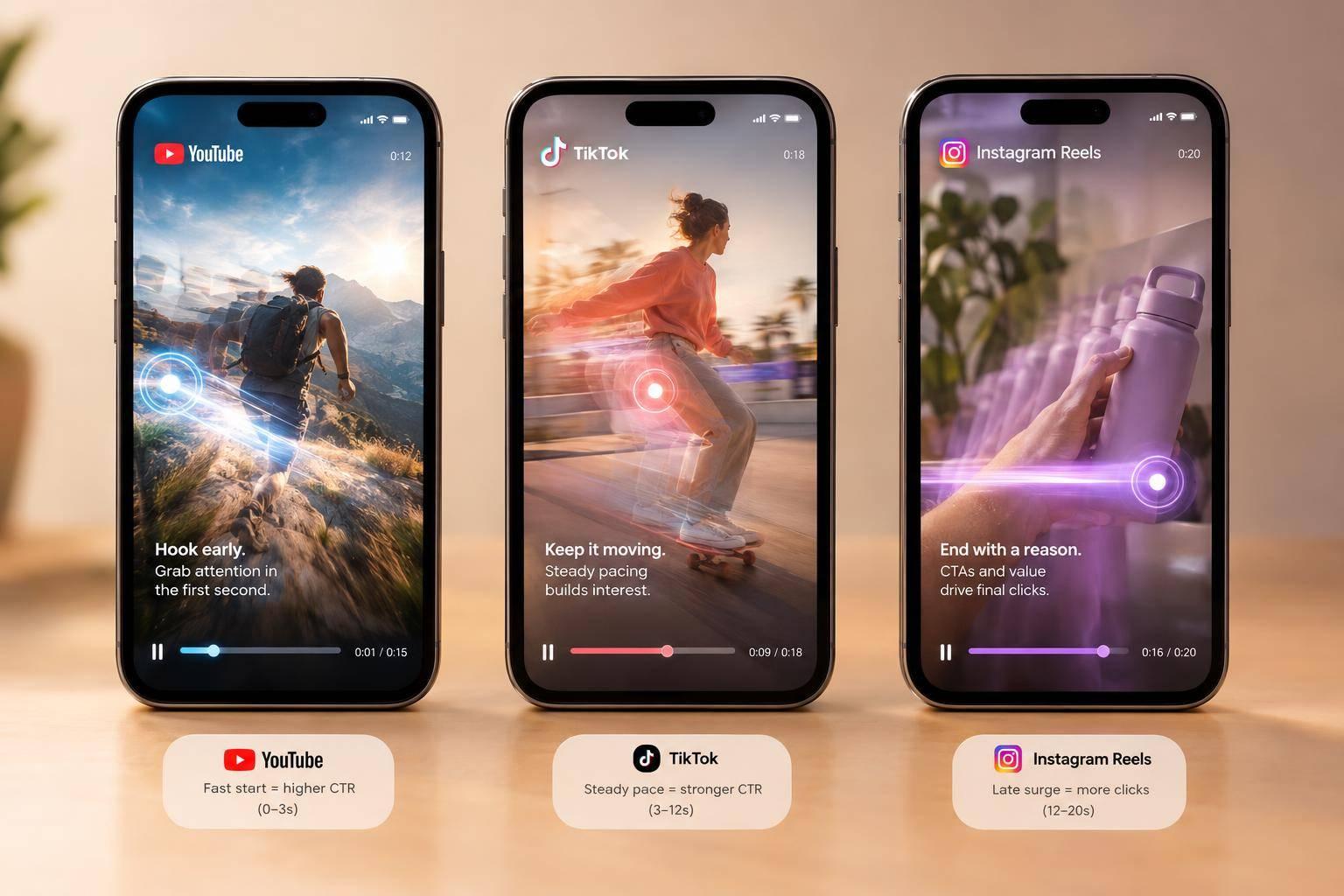
No platform always delivers the highest AI video CTR. I start by matching the opening, pacing, and CTA to how people watch - and where they can click. For a 30-second video, I’d test a hook in the first 1–3 seconds and one clear CTA near the end.
I compare YouTube Shorts, TikTok, Instagram Reels, Facebook, LinkedIn, and X across four factors: viewer intent, feed behavior, CTA placement, and video edits. Then I check whether clicks turn into leads or sales - not just whether CTR goes up.
Quick Comparison
| Platform | Viewer intent and feed | CTA path to check | Edit to test |
|---|---|---|---|
| YouTube Shorts | Discovery; swipe-based | Profile link or paid destination button | Immediate hook, tight explanation |
| TikTok | Entertainment; fast scrolling | Bio link or paid website/lead form | Fast opening, product proof |
| Instagram Reels | Visual discovery; profile-first browsing | Bio link or paid action button | Show the payoff before the CTA |
| Social updates and shopping; mixed placements | Post link or paid CTA button | More setup for feed, less for Reels | |
| Business research; context-led viewing | Post link or paid website/lead form | Business problem, then proof | |
| X | News and commentary; post-led discovery | Post link or paid destination | Clear post copy backed by video |
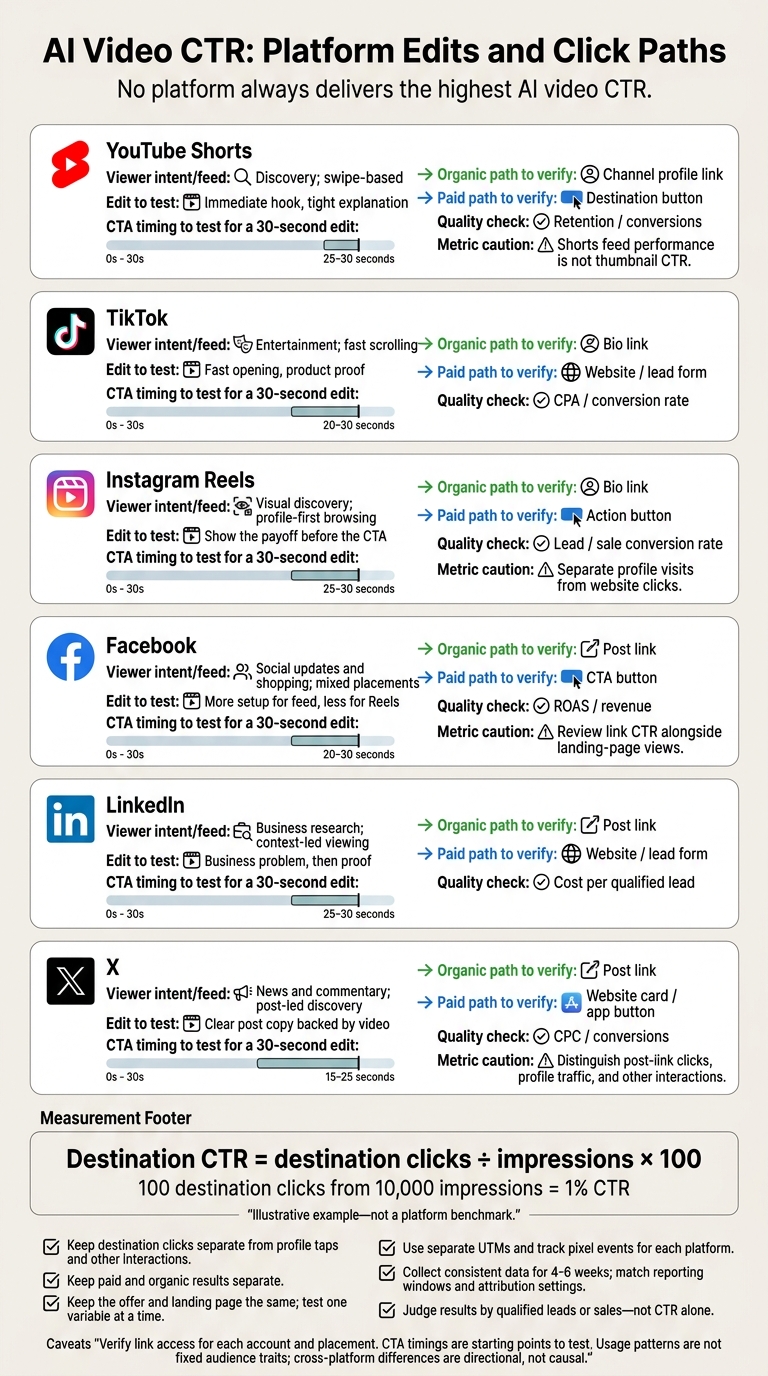
My measurement rule: <u>count destination clicks separately from profile visits and other interactions</u>. For example, 100 destination clicks from 10,000 impressions = 1% CTR. I keep paid and organic results separate, test one change at a time, and judge results by conversion quality as well as click volume.
AI Video CTR: Platform Edits and Click Paths
1. YouTube Shorts
Viewer Intent and Feed Behavior
YouTube Shorts centers on discovery. Win the first 1–2 seconds with a clear premise - not a logo or greeting. The swipe-based feed calls for an immediate hook, tight edits, and a CTA that fits the available destination.
Track viewed vs. swiped-away and 3–10 second retention to see whether your hook holds. If a strong hook leads to a sharp drop, the setup likely needs work.
CTA Placement
Once the hook holds, guide viewers from proof to action. In a 30-second Short, deliver the solution and proof during 10–25 seconds, then use a spoken and visual CTA in the final five seconds.
Shorts can also help viewers discover your long-form content. Match the CTA to the path viewers can actually take, and keep it clear of interface overlays.
Platform-Native Video Edits
For Shorts, editing pace matters more than depth. Keep the structure tight and captions easy to read. YouTube Shorts allows slightly more setup than TikTok or Instagram Reels, but the hook still needs to land immediately. Keep captions inside safe zones.
Test different opening statements or visuals without changing the explanation. Use AI avatars for explainers and hook tests, and real spokespeople for testimonials and authority cues.
CTR and Click Quality
Keeping viewers watching doesn't guarantee clicks. Shorts feed performance is not thumbnail CTR. Measure thumbnail CTR separately on other YouTube surfaces, then track destination clicks and the leads or sales they produce.
Views tell you whether a topic connects with viewers; conversions show its business value.
2. TikTok
Viewer Intent and Feed Behavior
TikTok favors speed over setup. Its entertainment-first feed rewards trend-led content and videos that grab attention immediately. Make the first frame stand out visually and verbally, using punchy lines and little setup in the first 0–3 seconds. That leaves less time to earn clicks, so CTA timing matters.
CTA Placement
Deliver the CTA in the last 5 seconds, pairing speech with matching on-screen visuals. Choose the link path the post supports: a direct destination link for paid posts and the clearest available link path for organic posts.
Platform-Native Video Edits
For synthetic UGC or product demos, move quickly from the problem to visible proof. Use the 10–25 second window to show the product in use rather than just describe it. Use AI avatars for hook tests and product demos, and real spokespeople for UGC-style, trend-led content.
CTR and Click Quality
On TikTok, attention quality matters as much as click volume. Read retention, destination CTR, and conversion rate together to judge click potential and whether those clicks turn into leads or sales. If clicks increase without conversions, review the landing-page journey and offer - not just the CTA. Track organic link traffic separately from paid destination clicks.
3. Instagram Reels
Viewer Intent and Feed Behavior
Instagram Reels favors polished, lifestyle-led brand content. Viewers often expect higher production quality and a stronger brand aesthetic. They also tend to check the profile before clicking through. Show proof before asking for action to match that profile-first behavior.
CTA Placement
Show the payoff first, then add a single CTA in the final seconds.
Platform-Native Video Edits
Use a captioned 9:16 cut, with text, logos, and the CTA inside safe zones. Re-cut the same script to fit Reels pacing and keep key elements clear of the interface. These edits reduce friction between watching the reel and clicking through.
CTR and Click Quality
Reels CTR isn't the same as raw engagement. For paid Reels, track destination clicks. For organic Reels, measure profile visits separately from website clicks - they're a step in the click path. Then judge website clicks by their lead or sale conversion rate.
4. Facebook
Viewer Intent and Feed Behavior
Facebook blends social updates, useful information, and shopping, so CTR depends on placement. Feed videos have room for a little setup; Reels need tighter hooks and a faster payoff. Track organic and paid results separately. Their distribution differs, which changes how soon a video needs to earn the click.
CTA Placement
For direct-response video, show proof first, then add one clear CTA in the final seconds. Match that CTA to the link path available in the post. The opening needs to hold viewers’ attention long enough for them to reach it.
Platform-Native Video Edits
Start with the problem or product - not a logo screen. Cut extra setup from the Reels version. Add captions and keep text within safe zones: feed and Reels videos often play without sound, and interface overlays can cover parts of the video. These edits help viewers stay until they see the offer.
CTR and Click Quality
For paid placements, review link CTR alongside landing-page views. A click alone doesn’t confirm that the page loaded. Keep paid and organic results separate. Check retention and completion to see whether viewers reached the CTA, then use conversions and ROAS to assess sales value.
5. LinkedIn
On LinkedIn, CTR is less about impulse clicks and more about reaching qualified buyers.
Viewer Intent and Feed Behavior
LinkedIn viewers often watch videos to solve a business problem or assess a vendor. Lead with the problem, then give just enough context to show why your offer fits. Clarity, proof, and relevance earn the click.
CTA Placement
Close with one outcome-driven CTA. For a 30-second video, dedicate the final 5 seconds to that action. In organic posts, direct viewers to the post link. In paid formats, align the CTA with the action button. The requested action and on-screen visual should match.
Platform-Native Video Edits
Use seconds 10–25 for a B2B demo, case-study proof, or customer evidence. Choose real presenters for B2B offers where trust matters most. Use AI avatars for lower-stakes product demos and high-volume hook testing. Make captions easy to read, size the frame for LinkedIn’s feed layout, and check terms and claims for accuracy.
CTR and Click Quality
Track destination clicks separately from reactions, comments, and other engagement. Assess CTR alongside qualified leads, form completions, and pipeline value. Strong engagement with weak conversions points to an offer or CTA that needs work. Use watch time only to check whether the opening held viewers’ attention.
6. X
Viewer Intent and Feed Behavior
On X, the post copy often earns the click before the video does. News, commentary, and post copy usually drive discovery. State the post’s claim clearly, then use the video to back it up. The post itself is part of the click path.
CTA Placement
Stick to one CTA that fits the post copy and link placement. Ask viewers to take one action rather than splitting their attention between clicking, following, and replying.
Platform-Native Video Edits
Open with a strong claim in seconds 0–3, explain the problem in seconds 3–10, then follow with proof and readable captions. After resizing, check that X’s interface doesn’t cover the captions, logos, or CTA.
CTR and Click Quality
On X, attention splits between link clicks, profile visits, and replies. Define what your CTR measures. When reporting separates these sources, distinguish video-associated clicks, post-link clicks, profile traffic, and reply-generated traffic before comparing platforms. Judge destination traffic by the leads or sales it produces, not total clicks.
Cross-Platform Comparisons and Test Design
These comparisons separate the variables that affect CTR: viewer intent, click path, hook speed, and conversion quality.
Viewer Intent and Feed Behavior
The same video can earn different clicks across platforms because each feed gives viewers a different reason to act. These are usage patterns, not fixed audience traits.
| Platform | Intent | Feed behavior | Click tendency |
|---|---|---|---|
| YouTube Shorts | Discovery | Swipe-based | High volume, mixed intent |
| TikTok | Entertainment | Trend-led | Impulsive clicks; needs an immediate hook |
| Instagram Reels | Social discovery | Visual-first | Visual appeal |
| Social / community | Mixed feed | Retargeting potential | |
| Professional research | Context-heavy | Lower volume, higher lead intent | |
| X | Topical browsing | Real-time | Topic-driven clicks |
Use these patterns to judge whether your CTA timing and edit style fit each platform.
CTA Timing and Link Access
Before publishing, check the actual link path for each account and placement. The CTA timings below are starting points to test with a 30-second edit.
| Platform | CTA timing to test | Post-copy role | Organic path to verify | Paid path to verify |
|---|---|---|---|---|
| YouTube Shorts | 25–30 seconds | Context | Channel profile link | Destination button |
| TikTok | 20–30 seconds | Search context | Bio link | Website / lead form |
| Instagram Reels | 25–30 seconds | Engagement | Bio link | Action button |
| 20–30 seconds | Context | Post link | CTA button | |
| 25–30 seconds | Professional framing | Post link | Website / lead form | |
| X | 15–25 seconds | Hook reinforcement | Post link | Website card / app button |
Hooks, Pacing, Captions, and Framing
Match the framing to the placement, make sure viewers can understand the video with sound off, and keep claims and supporting proof consistent.
| Platform | Hook | Pace | Captions | Framing | Close |
|---|---|---|---|---|---|
| YouTube Shorts | Pattern interrupt | Fast | Readable | 9:16 | Direct CTA |
| TikTok | Bold statement | Very fast | Stylized | 9:16 | Loop / CTA |
| Instagram Reels | Visual hook | Rhythmic | Minimal | 9:16 | Brand sign-off |
| Direct callout | Moderate | Descriptive | 9:16 / 4:5 | Solution + CTA | |
| Business pain point | Contextual | Clear | 9:16 / 1:1 | Proof + CTA | |
| X | Topical hook | Fast | Concise | 9:16 / 16:9 | Link + CTA |
Click Definitions and Conversion Quality
Label both the numerator and denominator. Keep destination clicks separate from profile taps and other interactions.
| Platform | Counted action | Reporting basis to verify | Quality check |
|---|---|---|---|
| YouTube Shorts | Destination click | Impressions; label view-based rates separately | Retention / conversions |
| TikTok | Destination click | Impressions | CPA / conversion rate |
| Instagram Reels | Website click | Impressions; separate profile-path traffic | Lead / sale conversion rate |
| Destination click | Impressions | ROAS / revenue | |
| Destination click | Impressions | Cost per qualified lead | |
| X | Destination click | Impressions | CPC / conversions |
Once you've defined the click, test one platform-native change at a time.
How to Test Platform-Native Video Edits
Keep the offer and landing page the same. Change only the hook or CTA wording, testing one variable at a time. Use separate UTMs and track pixel events for each platform.
Collect consistent data for 4–6 weeks before optimizing. Match reporting windows and attribution settings. Report retention, watch time, shares, conversions, CPA, and revenue where relevant.
Keep organic and paid results separate. Treat cross-platform differences as directional, not causal: audiences, delivery, auctions, and attribution differ.
What CTR Can Tell You - and What It Cannot
Platform-native edits change how people click, but CTR alone cannot prove business value. It shows interest, not intent. Assess it alongside placement, campaign objective, and downstream conversions.
This table separates what CTR tells you from what it leaves out.
| Platform | What CTR signals | Reporting limitations | Key companion metric |
|---|---|---|---|
| YouTube Shorts | Discovery response | Separate thumbnail and feed metrics | Retention and view duration |
| TikTok | Hook response | Engagement does not establish intent | Conversion rate (sales/leads) |
| Instagram Reels | Visual interest | Indirect organic link access | Profile visits and website clicks |
| Granular placement data | CTR varies by placement | Placement-specific ROAS | |
| B2B interest | Clicks do not establish buyer fit | Lead quality and job-title fit | |
| X | Topical response | Mixed attribution | Link clicks and profile visits |
Treat these patterns as troubleshooting cues, not verdicts.
- High retention + low CTR: Your CTA or click path may need work.
- Low retention + low CTR: The hook or audience fit may be off.
- High CTR + low conversion: Check the landing page and traffic quality. Does the page match the video’s promise?
- High engagement + few clicks: The video is driving awareness, not traffic. For a sales campaign, test a clearer reason to click.
- Moderate CTR + strong qualified leads or sales: The video may be filtering for better-fit buyers. Judge it by qualified outcomes, not click volume.
Conclusion: Match Video Edits to Click Goals
No platform always wins on AI video CTR. Choose based on audience intent, campaign objective, click path, and conversion quality. Viewer intent, feed behavior, CTA placement, and format edits all shape CTR. When intent, browsing habits, or the route to a click changes, CTR changes too.
For teams making multiple platform versions, tailor hooks, pacing, captions, framing, and CTA timing to each channel. Use faster openings on TikTok and Reels, and give viewers more context on Shorts and LinkedIn. Match each CTA to the available click path. Measure CTR by platform, then track conversion quality through campaign and destination tracking.
Sun Scroller supports this platform-native testing approach with AI avatars, synthetic UGC, product ads, cinematic storytelling, approved publishing, and per-channel analytics.
FAQs
How many impressions do I need for a reliable CTR test?
There’s no set impression count that makes a click-through rate test reliable. Post consistently for at least 4 to 6 weeks to give ad accounts and algorithms time to collect data, optimize performance, and show which hooks and formats work.
Your budget needs to support enough clicks or conversions to guide decisions. The testing period also needs to be long enough for the results to reflect typical performance.
Should I move my CTA earlier if viewers drop off?
Usually, no. Early drop-off often means your hook isn’t grabbing attention or your pacing is too slow. Sharpen your opening to stop the scroll, and give viewers a reason to keep watching through your visual demonstration.
Judge your call to action (CTA) by click data, not drop-off alone. If engagement is high but conversions are low, your CTA needs adjustment.
How do I attribute clicks that pass through my profile?
Add UTM parameters to links in your bio or profile description. These tracking tags show you which platform or video campaign sent traffic to your site in your analytics dashboard.
Use a clear call to action that tells viewers where to find the link. Keep your tracking structure consistent across social channels so you can accurately measure performance and conversion rates.