
Objection-Led UGC Ads: What Brands Miss
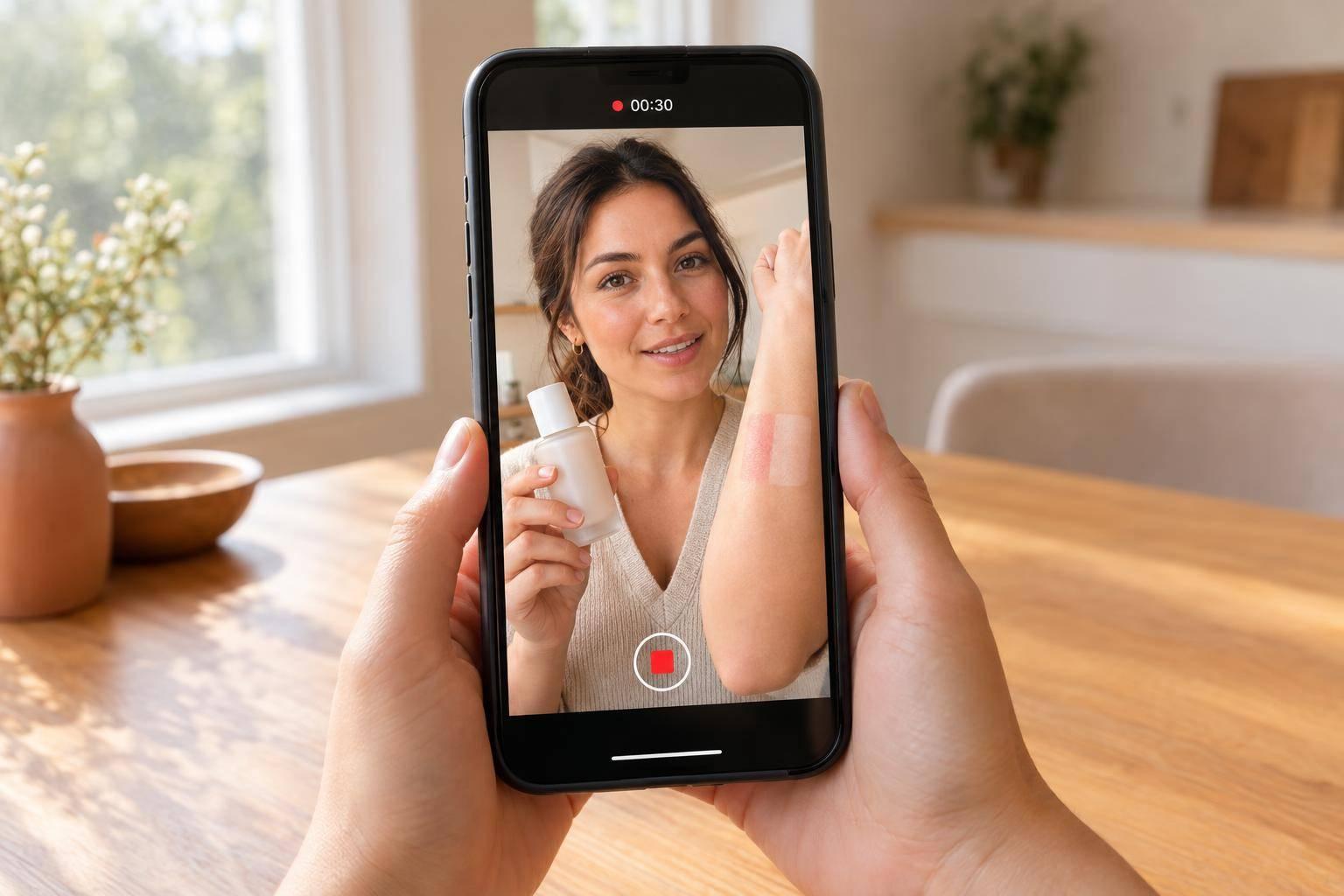
Objection-Led UGC Ads: What Brands Miss
I build objection-led UGC ads around one buyer doubt and one proof point - not a list of features. For a 30-second ad, I put the concern in the first 3 seconds, then show proof and give viewers one next step.
Here’s the approach I use:
- Find the doubt: Check reviews, support tickets, and return reasons for concerns that block purchases.
- Show the answer: Use setup footage, product tests, or customer statements that address that concern.
- Check the claims: Keep AI presenters separate from customer testimonials, and review permissions, supporting records, and disclosures.
- Test the message: Keep the audience, presenter, offer, and landing page fixed while comparing objection angles. I judge purchase campaigns by cost per purchase, not views alone.
- Scale approved ads: Review every final cut, keep the landing page aligned, and check that purchases hold up across platforms.
My rule: <u>prove the message works before making more versions.</u>
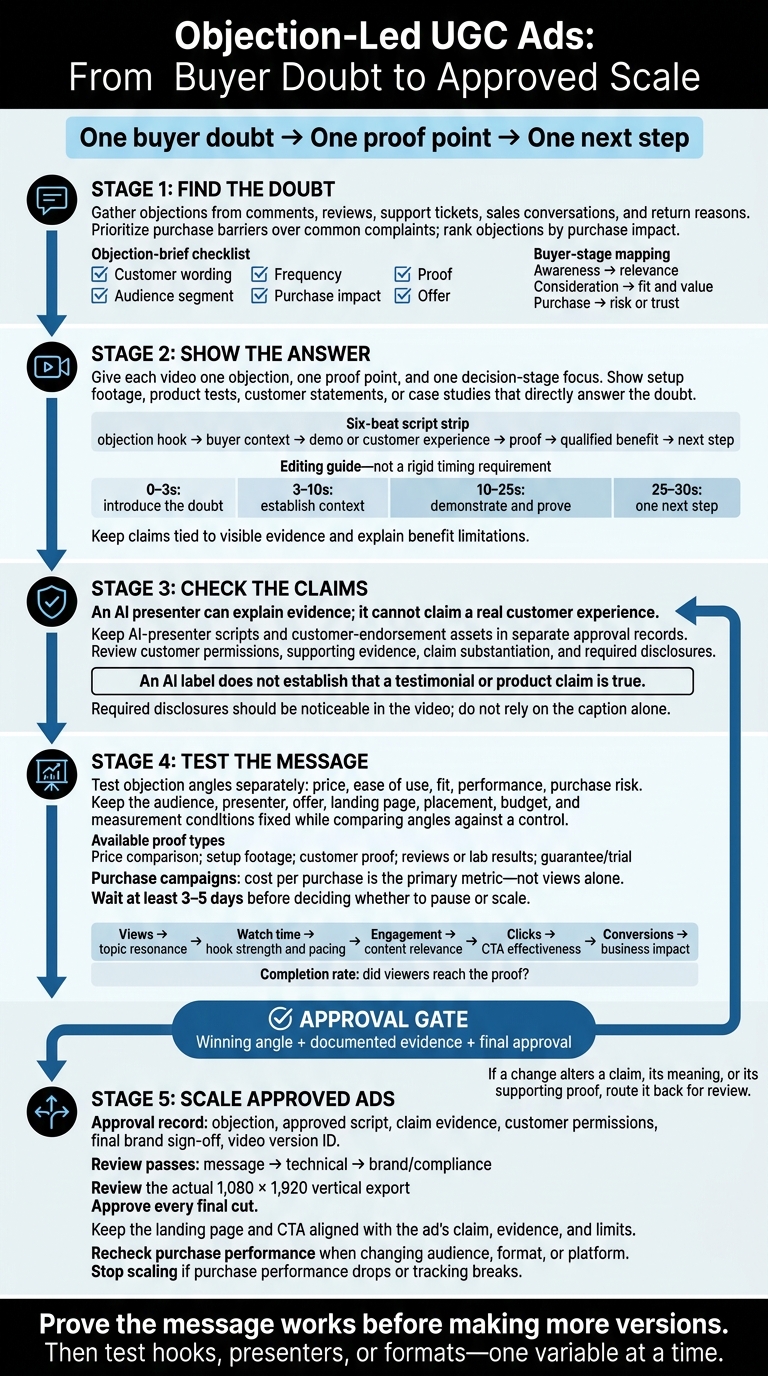
Objection-Led UGC Ads: From Buyer Doubt to Approved Scale
Find the Objections That Affect Purchases
Gather Objections From Customer Feedback
Review comments, reviews, support tickets, sales conversations, and return reasons for concerns that delay or stop purchases. Objection-led UGC shifts the focus from features to proof that answers buyer hesitation. Use customer feedback to pinpoint the friction the video needs to address.
Prioritize purchase barriers over common complaints. Focus on concerns linked to delayed decisions, lost sales, or returns.
Keep a shared objection brief so the team can choose scripts based on evidence:
| Brief field | What to record |
|---|---|
| Customer wording | The customer’s exact words and feedback source |
| Audience segment | The buyer group |
| Frequency | How often the concern appears |
| Purchase impact | Evidence of hesitation, a lost sale, or a return |
| Proof | A review, demonstration, before-and-after footage, or case study that answers the objection |
| Offer | The product, service, or offer the concern applies to |
Rank objections by purchase impact, then use the strongest one for the next video.
Match Each Video to One Objection
Map each ranked objection to the buyer stage it blocks: relevance at awareness, fit and value at consideration, and risk or trust at purchase.
Give each short video one objection, one proof point, and one decision-stage focus. Turn each objection into an ad angle, and choose proof that answers it directly. Service businesses can use case studies and client testimonials to make an intangible offer more concrete.
End with one next step that fits the audience and offer - not several competing CTAs.
Write an Objection-Led Testimonial
Once you know the top objection, build a script around it. Use six beats: objection hook, buyer context, demo or customer experience, proof, qualified benefit, next step. This gives you an ad angle you can test.
For a 30-second ad, show the doubt in the first 3 seconds and establish context by the 10-second mark. Use the next 15 seconds for proof, then save the final 5 seconds for the next step. Treat these timings as editing guides.
The proof needs to answer the buyer’s exact doubt.
Answer Doubts With Specific Proof
Show the answer through visible product behavior, setup steps, or customer evidence. Keep the claim tied to what viewers can see, and explain any limits on the benefit.
If buyers worry about setup, show the required accounts, permissions, and manual tasks. Repeat the same claim, evidence, and limits on the landing page - don’t promise more there than the video supports.
This distinction matters most when the video uses synthetic presenters.
Distinguish AI Presenters From Customer Testimonials
An AI presenter can explain evidence; it cannot claim a real customer experience. Make clear that the avatar is presenting customer evidence, not acting as the customer. If you share a real customer’s experience, get permission and support any claims about results with evidence.
Before publishing in the U.S., follow the rules for disclosures, claim substantiation, and synthetic media. Put required disclosures where viewers can clearly notice them in the video. Don’t rely on the caption alone.
An AI label does not establish that a testimonial or product claim is true. Permissions and supporting evidence still need a separate review.
Test Objection Angles and Measure Results
Once you’ve written the objection-led script, test which angle moves buyers. Test price, ease of use, fit, performance, and purchase risk separately. Run each against the control with the same audience, placement, budget, and measurement conditions.
Test Messages Before Presenters
Test objection angles before changing presenters. Pair each angle with one proof type:
Price comparison, setup footage, customer proof, reviews or lab results, or a guarantee/trial.
Name the objection early, then address it with proof. Measure whether the angle keeps viewers watching and prompts action.
Choose your primary metric before launch. For purchase campaigns, put cost per purchase ahead of views. Start with the smallest budget that produces meaningful data, and wait at least 3–5 days before deciding whether to pause or scale.
Track Retention, Clicks, and Purchases
Keep one entry for each variant, including the control. Track buyer response consistently so you can compare every angle on the same terms.
| Metric | What it reveals |
|---|---|
| Views | Topic resonance |
| Watch time | Hook strength and pacing |
| Engagement | Content relevance |
| Clicks | CTA effectiveness |
| Conversions | Business impact |
Use completion rate to check whether viewers reached the proof. Let these patterns guide what you refine next.
Move only the strongest angle into the review and scale phase.
Scale Proven Messages With Review Checks
Once an objection angle wins, save it in an approval record before scaling variations. Link the objection, approved script, claim evidence, customer permissions, and final brand sign-off to the video’s version ID. Document where customer footage or quotes can appear. If an edit changes a claim, its meaning, or the proof behind it, send it back for review. Scale only the approved version.
Review each cut in three passes: message, technical, and brand/compliance. Make sure the hook matches the proof, captions retain qualifications, and disclosures stay readable. Check audio, framing, and render quality, too. For vertical videos, review the actual 1,080 × 1,920 export - not just the script. Only approved cuts move into distribution.
Use Sun Scroller to Produce Approved Video Variations
After review, create controlled variations of the winning objection angle. Sun Scroller can produce approved variations and route them through brand review. Include the approved script and supporting evidence in the production brief so each variation stays within the approved objection, proof, and claim boundaries.
Keep AI-presenter scripts and customer-endorsement assets in separate approval records. Link genuine customer statements to their source and permission record. Use Sun Scroller’s brand review workflow to approve every final video before publishing on YouTube, TikTok, Instagram, Facebook, X, and LinkedIn.
When you change the audience, format, or platform, check channel analytics again to confirm the winning angle still performs. Stop scaling if purchase performance drops or tracking breaks.
Conclusion: Answer Buyer Doubts Before Scaling
Once an ad angle that addresses buyer doubts converts, keep the rest of the funnel aligned. The landing page and CTA should match the ad’s promise.
Start by testing one message variable. Keep the presenter, landing page, and offer fixed. Watch time and clicks help you spot what’s working, but purchases are the measure of success.
Once the message works, test hooks, presenters, or formats - changing only one variable at a time. Scale only answers that have proved they convert.
FAQs
Can highlighting buyer doubts hurt conversions?
Addressing buyer doubts doesn’t hurt conversions when done well. It can build trust and ease the hesitation that stops someone from buying.
Objection-led ads acknowledge viewers’ concerns and show how your product or service can help. Naming a specific pain point or doubt shows you understand their frustration, which helps earn trust. Instead of listing generic features, you give buyers the reassurance they need to act.
What if I don’t have customer testimonials yet?
Show what your product or service can do with product demos, before-and-after photos, or educational content that puts your service expertise on display. These formats can help build trust.
You can also use Sun Scroller to generate ad concepts based on proven frameworks and test messaging angles - even without existing social proof. Treat the content as a brand ad, not a review. Use clear storytelling to address customer objections and show how your offer helps them.
How much data makes an ad test reliable?
The provided materials don’t set a minimum data volume or impression count. Instead, they recommend controlled A/B testing: keep the script, visual pacing, and budget the same while changing just one element, such as the spokesperson.
Measure results by conversion rates and return on ad spend, not views. Look for patterns - like high engagement but low conversions - to guide the next version of your ad.