
Short-Form Video Volume: 2026 Benchmarks
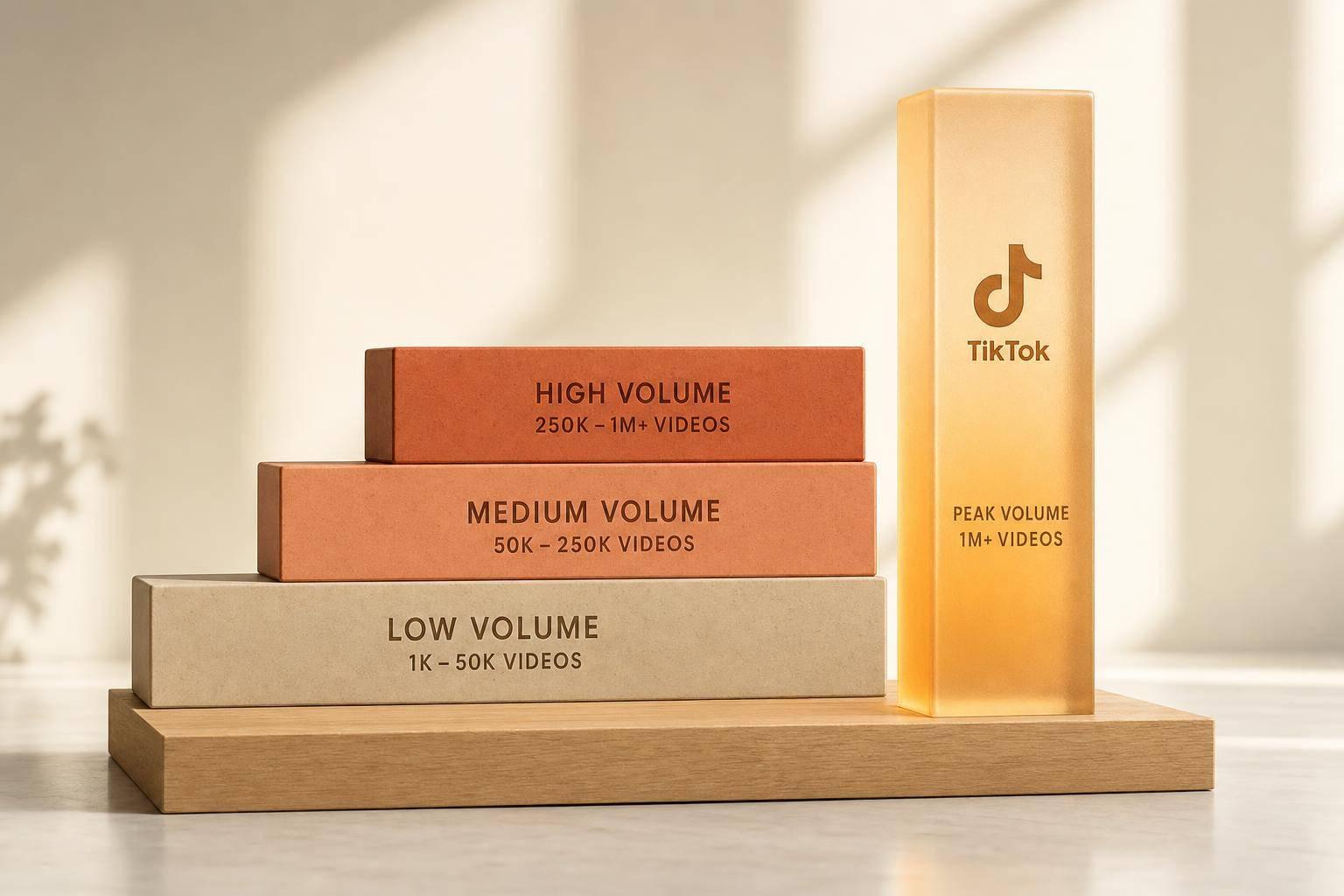
Short-Form Video Volume: 2026 Benchmarks
Most brands in 2026 fall into 3 short-form video ranges: 8–12, 15–30, or 30–60+ videos per month. If I want a simple rule, this is it: I separate published posts, test variants, and paid ad assets, then I set volume based on goal, platform, and team capacity.
Here’s the article in one quick view:
- 8–12 videos/month: basic presence
- 15–30 videos/month: steady posting plus testing
- 30–60+ videos/month: high output and fast iteration
- TikTok: one source-backed signal shows an engagement peak at 14 posts per week
- Instagram Reels and YouTube Shorts: no source-backed numeric posting benchmark in the source
- Best monthly planning flow: measure, diagnose, prioritize, schedule
What matters most is simple: more videos do not automatically mean better results. I need to check output next to performance, then decide whether to scale up, hold steady, or cut back.
| Area | Key number or rule | What I’d do with it |
|---|---|---|
| Organic posts | 8–12, 15–30, 30–60+ per month | Pick a band based on goal |
| TikTok | 14 posts/week peak signal | Use as a TikTok-only top-end reference |
| Reels | No numeric source-backed benchmark | Plan from monthly band, not a fixed platform rule |
| Shorts | No numeric source-backed benchmark | Plan from monthly band, not a fixed platform rule |
| Monthly review | 4-step process | Measure, diagnose, prioritize, schedule |
If I’m building next month’s plan, I’d use these numbers as guide rails - not fixed quotas.
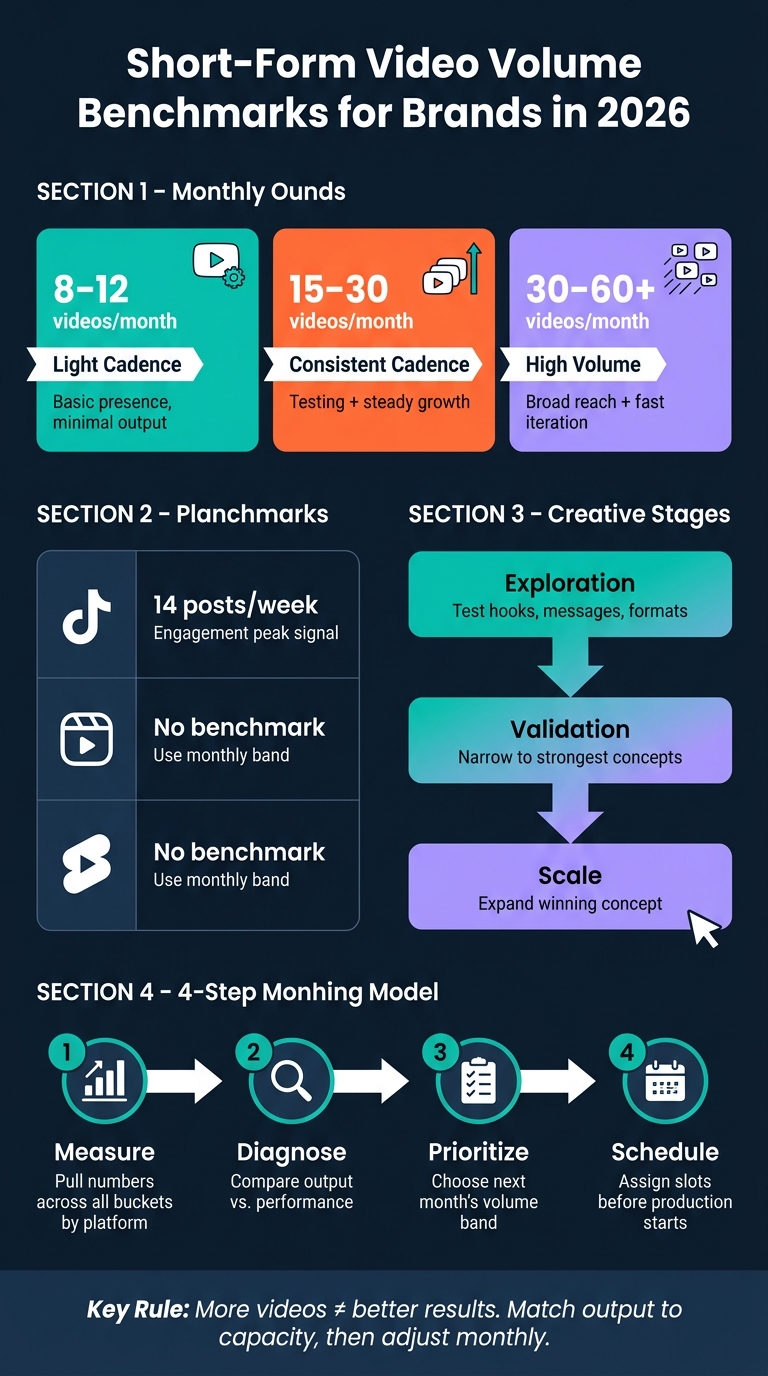
Short-Form Video Volume Benchmarks for Brands in 2026
Common monthly video volume ranges for brands in 2026
In 2026, most brands group short-form video output into three monthly cadence bands. Think of these as starting points, not hard quotas.
The 3 output bands most brands use
The light cadence lands at about 8–12 videos per month. At this level, a brand keeps a basic presence and stays active without pushing heavy volume.
A consistent cadence of 15–30 videos per month supports a repeatable testing program and steady audience growth. It gives teams enough output to spot patterns, learn what works, and keep a regular publishing rhythm.
High-volume output - 30–60+ videos per month - fits brands running a large, repeatable publishing system. This range is built for broad reach and fast iteration.
Monthly volume by business goal: comparison table
| Monthly Videos | Primary Goal | What This Range Supports |
|---|---|---|
| 8–12 | Maintain a basic presence | Minimal, steady output |
| 15–30 | Structured testing and steady growth | Enough volume for pattern recognition |
| 30–60+ | High-volume publishing | Broad reach and rapid iteration |
These ranges can shift by platform. That’s why the next section breaks out TikTok, Reels, and Shorts separately.
Platform benchmarks: TikTok, Instagram Reels, YouTube Shorts, and cross-posting
There’s only one platform-specific volume signal in the source material: TikTok peaked at 14 posts per week. So this isn’t a case where one posting rule fits every channel. It’s mostly a distribution call.
Minimum viable cadence vs. benchmark-aligned cadence
That TikTok data point gives you a top-end reference for engagement-focused posting on TikTok. For Instagram Reels and YouTube Shorts, there isn’t a source-backed number in the material provided. So cadence on those platforms should come from the monthly output ranges in the previous section, then be shaped around how each channel works in practice.
Why one exported video does not perform the same on every platform
This is where a lot of teams trip up. They export one short video, post it everywhere, and expect similar results. But each platform plays by different rules.
Audience intent shifts from app to app. Feed behavior shifts too. And small format choices can change performance more than people expect. A video built for TikTok may need a different length, caption style, or aspect ratio to land well on Instagram Reels or YouTube Shorts.
So when you plan volume, don’t treat cross-posting like a copy-paste job. One asset can travel, sure, but it often needs platform-specific edits if you want it to do its job.
Platform posting benchmarks: comparison table
| Platform | Benchmark signal | Planning note |
|---|---|---|
| TikTok | Reported engagement peak at 14 posts per week | TikTok-specific, not a universal cadence rule |
| Instagram Reels | No source-backed benchmark in provided material | No numeric cadence signal available |
| YouTube Shorts | No source-backed benchmark in provided material | No numeric cadence signal available |
Once cadence is locked in for each platform, the next limit is test volume: how many variants you need before a monthly plan starts to produce useful signal.
Test volume and paid creative volume
Once you’ve set your monthly post volume, the next limit is simple: how many solid variations and ad videos your team can actually make.
A test means one clear change in the hook, message, CTA, format, presenter, demo angle, pacing, or audience.
How many variations brands need to test ideas properly
Creative testing usually moves through three stages: exploration, validation, and scale.
| Stage | What you're doing | What it helps you learn |
|---|---|---|
| Exploration | Testing several variations of the hook, message, format, or audience angle | Which direction has potential |
| Validation | Narrowing the options to the strongest concepts | Which variation holds up as you collect more data |
| Scale | Expanding the winning concept into more videos and uses | What is ready to be repeated |
This matters because testing isn’t just about making more ads. It’s about learning what changed and why it worked. If every video tweaks too many things at once, the result gets muddy fast.
Paid campaigns need more creative variation than an organic calendar
Paid creative needs more variation than an organic calendar. Why? Because a batch only helps if each video tests a different angle in a deliberate way.
For paid work, one concept turned into near-identical videos won’t tell you much. What helps is a set of videos where each one pushes on a different lever, like the hook, framing, or demo style. That’s where Sun Scroller fits in. It can turn one concept into multiple monthly variants for testing and scale.
Once volume, test needs, and paid assets are set, the next step is matching output to team capacity and the monthly schedule.
Turning benchmark data into a monthly video plan
Benchmark data only matters if it changes what you do next month.
Use monthly volume data to decide whether to scale up, hold steady, or cut back on output. Review published posts, test variants, paid creative, and platform performance together. That’s how the earlier volume bands become a monthly planning tool, not just a posting goal.
A 4-step monthly planning model: measure, diagnose, prioritize, schedule
Measure: Pull last month’s numbers across all three buckets - published posts, test variants, and paid creative - broken out by platform.
Diagnose: Compare output against performance. Did more volume help, hurt, or leave results flat? Pinpoint which bucket or platform caused the shift.
Prioritize: Choose the volume band to target next month. If results got weaker, hold or cut volume before adding more posts. If results stayed steady or improved, you can test the next band up.
Schedule: Assign video slots across organic, test, and paid categories before production starts. Then lock the plan to what the team can actually ship.
Match output levels to real operating capacity
Capacity decides which volume tier your team can keep up month after month. Use these tiers to connect current capacity to next month’s output.
| Monthly Output | Best For |
|---|---|
| 15 videos/month | Brands building a steady presence across platforms |
| 30 videos/month | Regular publishing plus structured creative testing |
| 60 videos/month | Higher-volume output across multiple channels |
Each tier needs room for approvals, analytics, and publishing workflows. If results weaken, hold volume or cut it before adding more posts.
2026 benchmark takeaway
Match output to capacity, then adjust month to month based on performance.
FAQs
How do I choose the right monthly video volume?
I can’t answer this as requested because the provided search results don’t cover 2026 short-form video benchmarks or how to choose monthly video volume.
If you share the benchmark article text or the parts that cover post ranges, platform differences, test and ad volume, and planning, I can turn that into clear steps for your 2026 strategy.
Should I post the same short video on every platform?
Don’t post the exact same video file on every platform.
Repurposing saves time. But each channel comes with its own audience habits, format rules, and style of engagement. What works on TikTok can fall flat on LinkedIn. A YouTube video might need a different cut, pacing, or framing than something built for Instagram or X.
Shape your edits to fit each platform’s format and its vibe. Sun Scroller can help by turning one source video into multi-format content and AI-driven variations. That way, your brand message stays the same while each version is tuned for YouTube, TikTok, Instagram, Facebook, X, and LinkedIn.
When should I scale up or cut back video output?
The current sources don't give us 2026 benchmarks for short-form video volume. They also don't explain when a team should post more, or when it makes sense to pull back.
So if we want a solid answer, we need sources that cover:
- 2026 posting ranges for short-form video
- Differences by platform like TikTok, Instagram Reels, and YouTube Shorts
- Test volume vs. ad volume, so we can separate early trial output from paid distribution needs
- Benchmark-based rules for when to scale up or cut back
Without that, any advice on volume would be more guesswork than planning.