
Voice Cloning for TikTok Ads: Brand Guide
Voice Cloning for TikTok Ads: Brand Guide
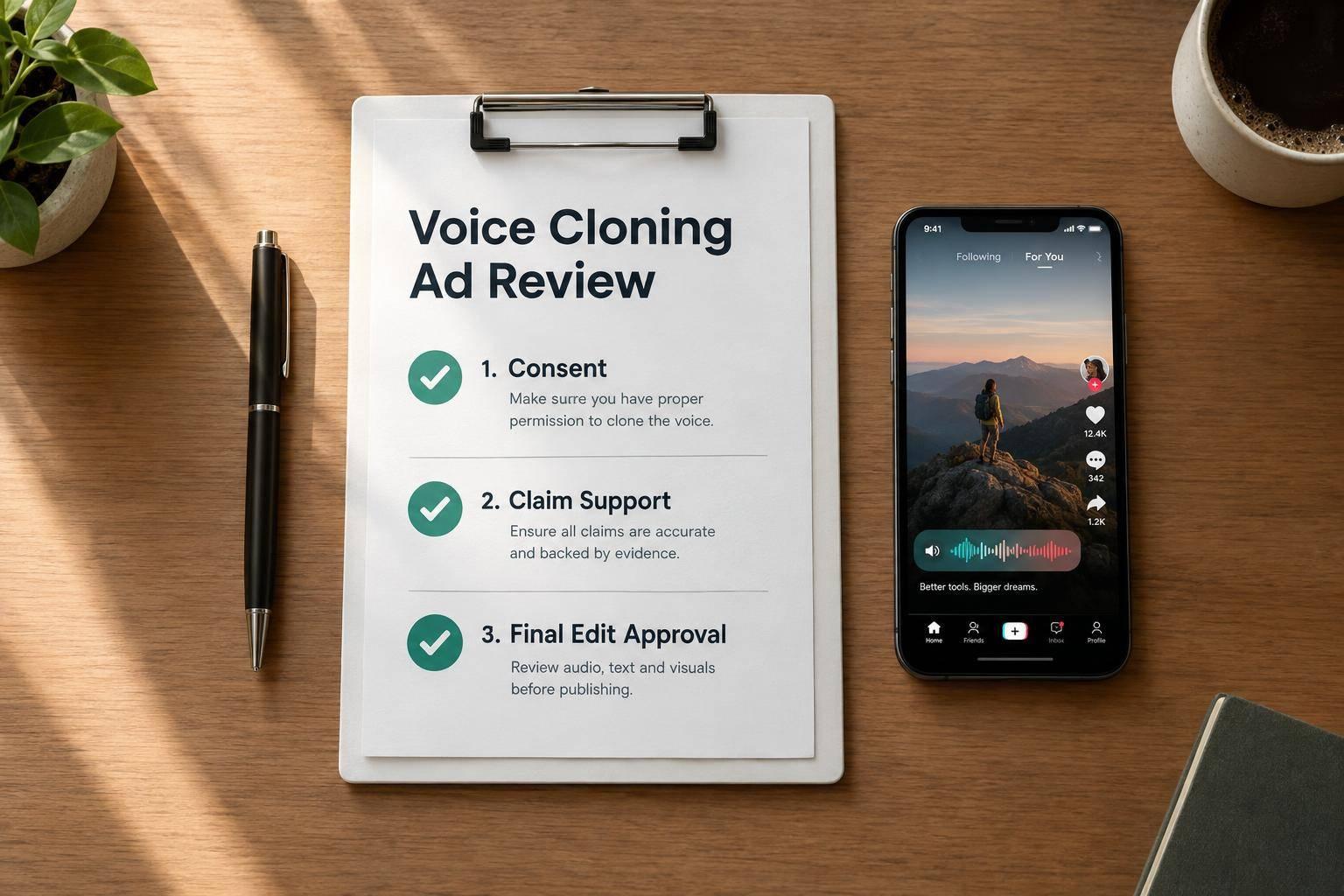
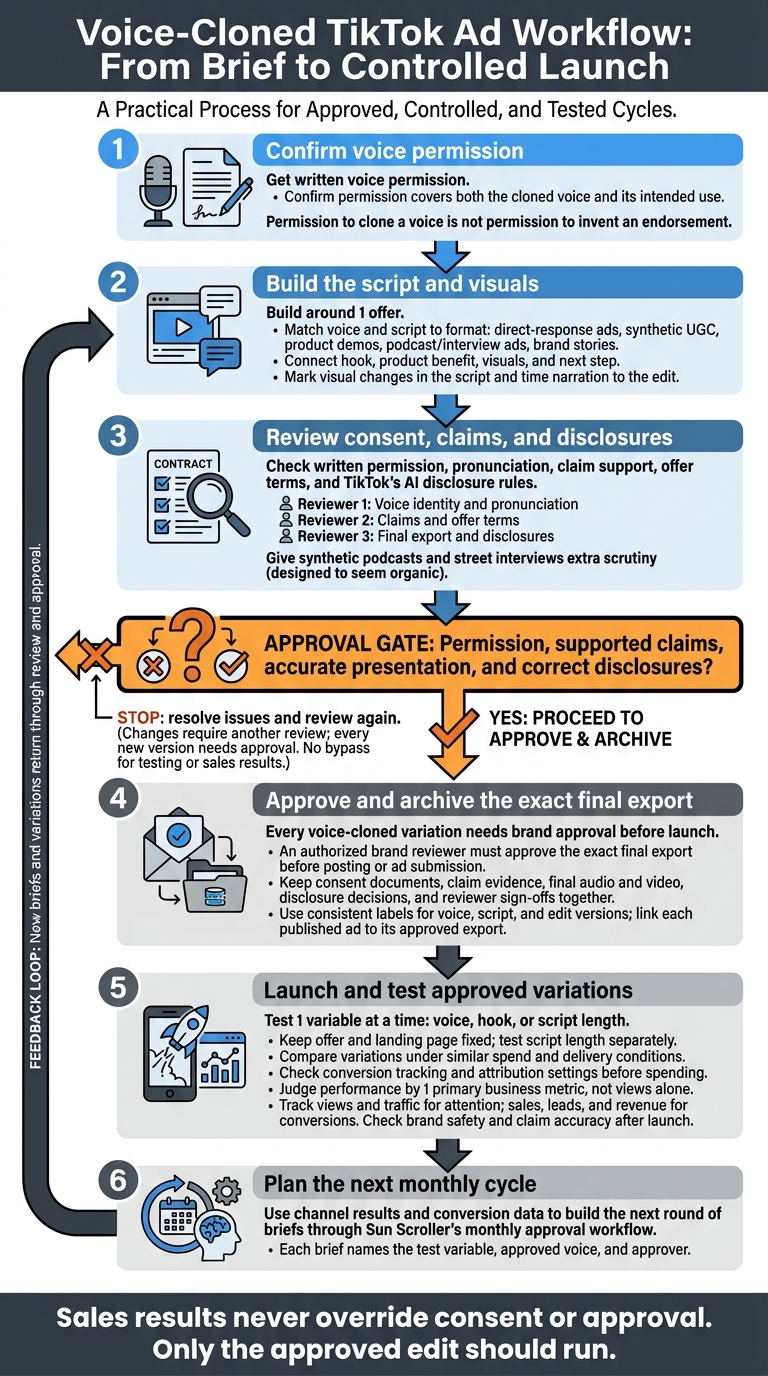
My rule for voice-cloned TikTok ads: get written voice permission, support every claim, and approve the exact final video before launch. Permission to clone a voice is not permission to invent an endorsement.
I use this checklist to move from script to test:
- Match the voice and script to the format: direct-response ads, synthetic UGC, product demos, podcast/interview ads, or brand stories.
- Build around 1 offer: connect the hook, product benefit, visuals, and next step.
- Review before posting: check consent, pronunciation, claim support, and TikTok’s AI disclosure rules. Save the approved export and review records.
- Test 1 variable at a time: compare voice, hook, or script length while keeping the offer and landing page fixed. Judge results by 1 primary business metric, not views alone.
- Plan the next month: use results to build new briefs and route them through Sun Scroller’s approval workflow.
My bottom line: <u>sales results never override consent or approval</u>.
Voice-Cloned TikTok Ads: Approval and Testing Workflow
Write Scripts for Each Ad Format
Build the script, cloned voice, and shot plan around one offer. Set the brand goal and ad format before you write. Give every line a clear visual purpose: introduce the product, show it in action, back up a benefit, or guide the viewer to the next step.
Use the three blocks below to shape the hook, pair the voice with the edit, and fit the script to the format.
Build a Hook, Benefit, and Call to Action
Start with the offer or the viewer’s problem. Then move straight into one benefit, demonstration, or proof point. End with an action that fits the destination.
For creator-style ads, speak directly to the viewer. For product demos, start with the product in action. For storytelling, link the origin story to the offer.
Keep the opening short and focused on one hook. Test variations later.
Sync Creator-Style Pacing With Visuals
Add natural pauses to synthetic UGC so the delivery feels less rehearsed. In product demos, time the narration to the feature on screen. Give scene changes and captions room without crowding the audio.
Mark every visual change in the script to keep the pacing on track during editing. Creator-style delivery should sound like a recommendation, not a scripted testimonial.
Choose a Voice Style for Each Format
Use a conversational voice when speaking directly to viewers, precise narration for technical details, and slower storytelling when the visuals need time to make their point. Match the delivery to the message instead of using the same energetic voice for every format.
| Format | Voice style | Script structure | Production checks |
|---|---|---|---|
| Direct-response product ads | Energetic, benefit-led | Offer → benefit or proof → CTA | Make the offer and CTA audible; match spoken details to on-screen text. |
| Synthetic UGC-style ads | Conversational, with pauses | Viewer’s problem → product benefit → next step | Avoid unsupported first-person experience. |
| Product demonstrations | Precise, measured | Feature → visible action → benefit → CTA | Time narration to product actions; use accurate cutaways. |
| AI podcast/interview ads | Casual, high-trust | Question → insight → solution | Write short exchanges rather than monologues. |
| Cinematic brand stories | Slower, expressive | Origin story → emotional payoff → next step | Match B-roll intensity to narration; keep origin-story claims accurate. |
With the format and pacing set, move the draft into disclosure and claim review.
Review Disclosures and Approve the Ad
Once the script and edit are locked, begin compliance review. Check consent, claims, and disclosures during production - not on upload day. Every voice-cloned variation needs brand approval before launch. Start with disclosures and claims, then assign reviewers.
Check AI Disclosures and Ad Claims
Confirm that written permission covers both the cloned voice and its intended use. Before submission, check TikTok’s disclosure rules for AI-altered audio. Match every spoken claim to supporting evidence and the offer terms.
Give synthetic podcasts and street interviews extra scrutiny: they’re designed to come across as organic content.
Assign Reviewers and Approve the Final Edit
Assign one reviewer to check voice identity and pronunciation, another to check claims and offer terms, and a third to check the final export and disclosures. An authorized brand reviewer must approve the exact final export before posting or ad submission.
Block approval if permission is missing, claims lack support, the presentation is misleading, or disclosures are incorrect. Any change to those elements requires another review.
Log Versions and Approvals
After approval, archive the final export and sign-offs. Use consistent labels for each voice, script, and edit version. Keep consent documents, claim evidence, final audio and video, disclosure decisions, and reviewer sign-offs together.
Link each published ad to its approved export. Pronunciation rules and the brand style guide are references only - not substitutes for approval. Every new version still needs approval.
Test Ad Variations and Plan Monthly Production
Test Voice, Hook, and Script Length
Once an ad is approved and live, test one variable at a time to find the best performer. Use an AI Hook Matrix to test combinations of voice style and visual hook, but change only one variable in each comparison. Keep the offer and landing page fixed, and test script length separately. Compare variations under similar spend and delivery conditions so you can tell what drove the results.
Measure Attention, Sales, and Brand Risk
Before spending, check your conversion tracking and attribution settings. Track views and traffic to measure attention, then sales, leads, and revenue to assess conversions.
Choose one primary business metric to judge performance. After launch, check brand safety - including claim accuracy - to decide which variations move forward. Views alone don’t make an ad a winner. Use these results to choose what enters the next monthly production cycle.
Plan Monthly Ad Variations With Sun Scroller
Once you find a winner, use Sun Scroller’s monthly workflow to turn winning TikTok tests into the next round of approved voice-cloned ad briefs. Its brand voice guide, async approval, and per-channel analytics support this cycle.
Each brief should name the test variable, approved voice, and approver. Use channel results and conversion data to shape the next monthly plan.
Conclusion: Launch an Approved Voice Cloning Test
Once the test plan is set, use the launch brief to lock in the approved version. Make it your launch checklist. Document the authorized speaker’s consent and permitted uses. Keep every script aligned with the approved voice, hook, and format.
Before the first upload, check the evidence behind claims, AI disclosures, and voice accuracy. The brand’s designated approver must sign off on the exact final edit, not just the script, before launch. Store the consent record and approval with the final export so the team knows which file is cleared to run.
Launch only approved variations that meet your business goal. Sales performance never overrides consent or approval. Only the approved edit should run.
FAQs
What should my voice-cloning consent agreement include?
Your agreement should explicitly cover the use of your brand’s actual material and tone to build the synthetic voice. It should also spell out how the AI-generated content may be used.
Define the production workflow, too. Can the provider generate and publish content under your brand style guide without your approval for each script or video? Include quality-control terms that give you the right to request changes or redos when content falls short of your brand standards.
How long should my voice-cloned TikTok ad be?
Keep your voice-cloned TikTok ad short and fast-paced to hold viewers’ attention. Test different lengths, visual hooks, and voiceover combinations to find the duration that works best for your audience.
Sun Scroller also produces 5- to 10-minute educational explainers for search engine optimization, but its TikTok ad variants are short-form assets. Sun Scroller manages production to match the platform’s fast pace.
How much data do I need to pick a winning ad?
Test more ad combinations to find what works. Pair 20 different visual hooks with 5 voiceovers, and you can produce up to 100 ad variants. Performance data shows which visuals and voiceovers connect best with your audience - no guesswork needed.
Sun Scroller manages production so you have enough content to test and optimize your campaigns.