
YouTube Shorts Hook Guide for Brands
YouTube Shorts Hook Guide for Brands
If your YouTube Short doesn’t show the point in the first 1–3 seconds, many viewers will swipe away.
I’d sum it up like this: show the value at once, match the visual and words, fit the hook to buyer intent, and test hook versions with retention and conversion data. The first frame should show action. By second 1, I’d name the problem or result. By seconds 2–3, I’d give proof.
Here’s the full article in one quick scan:
- Start with action, not logos, greetings, or slow setup
- Use one clear promise across visual, spoken line, and text overlay
- Match the hook to viewer stage, from problem-aware to ready-to-buy
- Shift the opener by offer type, like product, service, software, or B2B
- Tie the hook to the sales goal: awareness, consideration, conversion, or retention
- Track first-second retention, watch time, completion rate, clicks, and conversions
- Fix weak hooks by spotting where drop-off starts
A simple benchmark: if viewers leave in the first second, the opening likely wasn’t clear or specific enough. If they stay early but drop later, the payoff came too late. And if watch time looks good but sales don’t, the hook may have pulled in the wrong people.
The main idea is simple: I’d treat hooks like a system, not a guess.
How YouTube Shorts Hooks Work in the First Seconds
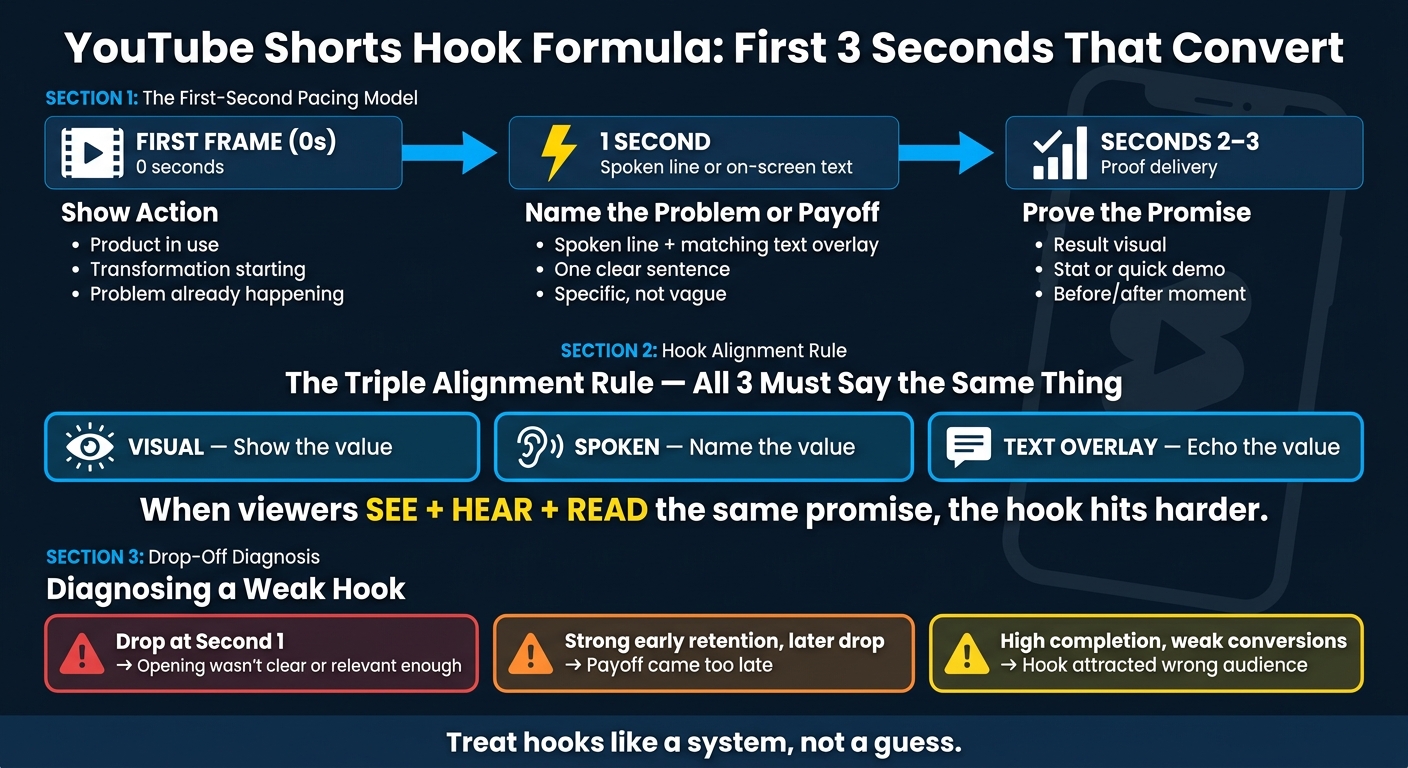
YouTube Shorts Hook Formula: First 3 Seconds That Convert
For brands, the opening seconds need to show value right away, not warm-up. Every beat should push the viewer closer to what the video promises.
Use the First-Second Pacing Model
The first frame should show action. That can be the product being used, a clear result, or the problem already happening on screen.
By 1 second, the spoken line or on-screen text should say the problem or the payoff.
Seconds 2–3 should give proof that the video is going to deliver.
| Moment | What to Show | Example Cue |
|---|---|---|
| First frame | Action or movement | Product in use, transformation starting |
| First second | Problem or payoff | Spoken line + matching text overlay |
| Seconds 2–3 | Proof | Result visual, stat, or quick demo |
This pacing works best when the visual, spoken, and text elements all say the same thing. If one part says “fast fix” but another part feels slow or vague, the hook starts to slip.
Openings That Lose Viewers Fast
Openings that delay the action or hide the main point lose viewers fast. If the motion starts late, or the message takes too long to land, the hook loses steam. And if the point shows up too late, the hook doesn’t work.
Once the sequence is clear, the visuals, spoken lines, and text overlays should all back each other up. That alignment is what the next section builds with visuals, spoken lines, and overlays.
Build Hooks With Visuals, Spoken Lines, and Text Overlays
Once the first-frame timing is locked in, the hook only works when the visual, spoken line, and text overlay all point to one clear promise.
Choose a Visual Opener That Proves the Promise
Your opening visual should do one of three things right away:
- show the product being used
- show the problem already happening
- show the result
Don’t spend those first moments setting up background or easing into the brand. That’s too slow. If people can see the value in the first frame, they have a reason to keep watching.
Put the result up front. Then use the rest of the video to explain how it works.
Write a Spoken Line and Text Overlay That Match
The spoken line should be short and specific. One sentence is enough. Name the problem or name the payoff.
The text overlay should echo that same promise. It shouldn’t introduce a second point. If the voice says one thing and the text says another, the viewer usually catches one and misses the other.
Keep both tight. Keep both aligned. Make sure they say the same thing at the same time.
When a viewer sees the value, hears the value, and reads the value all at once, the hook hits harder. Each part should prove the offer fast, not just make the video look nice. That message should shift based on viewer intent and the type of offer.
Match the Hook to Audience Intent, Offer Type, and Sales Goal
A hook works best when it matches what the viewer wants, what you're selling, and what you want them to do next.
Adjust Hooks to Viewer Intent
Not every viewer is in the same spot. Someone who just realized they have a problem needs a very different opening from someone who's already comparing options and getting ready to buy.
Here’s the simple way to think about it:
| Viewer Intent | What They Need From the Hook |
|---|---|
| Problem discovery | Name the unsolved problem. |
| How-to learning | Signal one clear fix. |
| Comparison / close to buying | Lead with proof and differentiation. |
| Product evaluation | Show proof suited to the viewer's stage. |
| Returning viewers / existing customers | Tease new value or what's next. |
The main point is simple: match the hook to the viewer's stage, not your preferred pitch.
Once you know the intent, you can shape the opening around the offer itself.
Change Hook Style by Product, Service, or Software Offer
Different offers need different openings. A hook that works for a physical product can fall flat for a service or SaaS tool.
Physical products need visual proof right away. Show the product doing something. A before-and-after or a quick moment of use tells the story faster than a spoken setup.
Service businesses should lead with the pain, not the pitch. Start with the problem or the outcome people want. Skip the credentials at the start.
Software and digital tools usually work best when the hook goes straight to the workflow win. Show the before state, then the better workflow. Lead with time saved or steps cut, not features.
B2B hooks need to call out the role or the work problem in the first second. If the opening is too generic, the right viewer is gone before the message lands.
Then you line that opening up with the funnel stage.
Align Hooks With Awareness, Consideration, Conversion, or Retention
Your sales goal changes the job of the hook.
- Awareness: open with curiosity or contrast.
- Consideration: show how it works.
- Conversion: remove doubt with proof.
- Retention: tease new value or a new use case.
Build a Repeatable Hook Testing Workflow for Brand Teams
Once the hook lines up with search intent and the offer, the next step is simple: test which version wins.
Brand teams should treat hook writing like a repeatable system, not a one-off call made on gut feel. Teams get better YouTube Shorts results by testing hooks in rounds. That’s how you find out which hook angle works on screen, not just in a brainstorm.
Build a Hook Matrix and Measure the Right Signals
A hook matrix lets you change one variable at a time while keeping the rest of the Short the same. That could be the visual opener, the spoken first line, the text overlay, or the audience segment.
Why does that matter? Because it helps you isolate what’s driving performance instead of guessing after the fact.
Measure performance across three layers:
- Early retention in the first 1–3 seconds shows whether the hook stopped the scroll.
- Average watch time and completion rate show whether the video delivered on the promise.
- Clicks with downstream conversions show whether the hook brought in the right viewers, not just more of them.
Views by themselves can send you in the wrong direction. A hook might pull in solid view counts and still attract people who never buy, sign up, or come back.
Diagnose Weak Hooks and Fix the Next Batch
The metrics usually tell you where the hook broke down. Look at the timing of the drop-off. That’s often where the problem starts.
- A first-second drop usually means the opening wasn’t clear or didn’t feel relevant.
- Strong early retention followed by a later drop usually means the payoff showed up too late.
- High completion with weak conversions usually means the hook pulled in the wrong buyers.
Once you spot the failure point, the next move is often pretty direct: rewrite the first line, bring the payoff forward, or tighten the audience cue in the opening frame.
Then test the revised version against the original using the same metrics. That apples-to-apples setup gives your team cleaner readouts and better calls for the next round.
Conclusion: Core Rules for Stronger YouTube Shorts Hooks
Test hook variations on a steady cadence, and keep the promise of the hook lined up with the payoff in the video.
FAQs
How long should a Shorts hook be?
The supplied sources don't give any guidance on YouTube Shorts hook length or first-second pacing.
They seem unrelated to that topic, so there's no way to pin down the right hook duration from those sources alone.
Based only on the sources provided, there isn't a supported answer.
What makes a strong hook convert, not just get views?
A strong hook works when that first second lines up with what your target audience wants to see, not just when it gets broad attention. It needs to stop the scroll and quickly show a product benefit or service solution, whether that comes through spoken lines or text overlays.
When your hook style lines up with your sales goal, the people who pause are more likely to care about your brand. That’s how you move from simple curiosity to action.
How often should brands test new hook versions?
Brands should test new hook versions on a steady basis if they want to keep performance up. On YouTube Shorts, engagement can shift fast, so a hook that works this week might lose steam not long after.
A simple way to handle this is to rotate and test hooks every week or every other week. Look at which visual openers, spoken lines, and text overlays get the best response from your target audience. Sun Scroller can help by supplying steady monthly short-form content along with performance analysis.